Welcome to the PAA Blog
Papahānaumokuākea 'Ahahui Alaka'i (PAA) is a ten-day experiential leadership program that brings together teachers, business people, policy-makers as well as potential community leaders interested in learning and being inspired by science and traditional knowledge management practices. Papahānaumokuākea Marine National Monument encompasses roughly 140,000 square miles of the Pacific Ocean, an area larger than all the country's national parks combined. The area around the Northwestern Hawaiian Islands is an important safe haven for wildlife such as the threatened green turtle and the endangered Hawaiian monk seal. ‘Ahahu‘i refers to society, club or association. Alaka’i is Hawaiian for ambassador or leader. The Hawaiian word /acronym PA‘A means steadfast, learned, determined, strong, to hold, keep, retain.
Saturday, June 27, 2009
A Message from Ron: Nichol and Fred
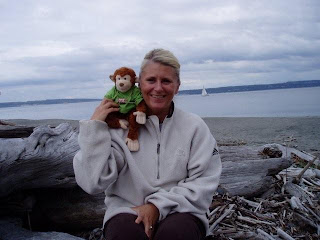
When I was on Midway, I learned that our daughter, Nichol, had been hospitalized with a serious condition......This was not easy as a Father. But home now, Nichol is doing better and has been sent many kind words from PAA Ohana. Here she is on Marrowstone Island with Fred. Fred is a monkey who kinda stole everyone's heart on our journey. He messed up a Kindergarten Classroom last year and will continue to travel with me to share our work with kids in a fun and postive way. Fred wears a band from a Papahanaumokuakea Albatross and talks story with the best of monkeys. Look for him and his sister, Coco wherever you travel.
Ron Hirschi, Marrowstone Island, Washington
PAA Last Will poem: by Carlie Wiener
To the PAA group on your final day
This last will and testament will be my final say.
This trip has been amazing and oh so much fun,
And we’re all going back 20 pounds heavier, our gluttony is done.
Where will we go at 4:30 next week?
Captain Brooks will be far away and the boluses with squid beaks.
So with this farewell, here we go,
What I leave to you based on what I have gotten to know...
To Annie a song for the world to hear,
And to Terry some fish nets making traditional Hawaiian gear.
To Darius, well um what can I say?
Dessert perhaps, with your plate of whip cream everyday.
To Jeff we wish we could leave you here,
To become one with the albatrosses and soar far and near.
And to your partner in crime, yes Ron that is you.
Swimming with the fish and then we will ID you too.
And while you’re at sea being one with the fish,
We will send you a postcard with our environmental wish.
A ray of sunshine our Sunny is,
And for you dear Sunny we leave you a green harvest biz.
With all the room on the Hilo side,
We will take the profits sand make you our monk seal guide.
And Karen, wow have you stopped smiling yet?
Your positive energy is not easily met.
And for you, well what do we give?
A journal for your amazing work and a marine debris sieve.
And Miriam our triathlon champ,
A jar of peanut butter for snacks while at camp.
Kathy my roommate with your energy and heart,
To you I give an alarm clock that never really starts.
Trevor kept the kokua the whole trip through,
And we should leave him a life jacket for when he goes overboard too.
Now Meg how about a pair of walking shoes?
Your falling fate would not make the Midway news.
And now for the facilitators, where would we be without you?
Well how about lets start with the biggest mahalo for all that you do.
To Dani, we leave your interviews done,
So you can get on with it and have some fun.
We also leave you any Midway sport,
From darts to bowling she’s the best in the court.
To Linda we leave you a funny hat,
And an official schedule with no changes, how about that?
To Anne we leave lots of string to perfect your braiding arts,
And find your wow moment in tiny sand dollar parts.
Walter Bea is next with her patience and smile,
I promise one day our E Ho Mai will get some real style.
And last but not least Tracy our faithful guide,
To you we leave a day off to enjoy the outside.
And so this concludes the PAA Last Will.
I can't believe its over, I really have the chills.
I will miss this group and the inspiration they provide,
We are now connected tested, trued and tried.
So please remember each other in the projects that you do,
And our time at Midway this special place and our friends here too.
Although you won't get to sort through carcasses everyday,
The messages you bring home will be the inspiring way.
And to you all I bid a safe trip home,
To release your environmental ethics under the education dome.
And once more a mahalo to the Midway staff team,
For you really all made our whole group beam.
This last will and testament will be my final say.
This trip has been amazing and oh so much fun,
And we’re all going back 20 pounds heavier, our gluttony is done.
Where will we go at 4:30 next week?
Captain Brooks will be far away and the boluses with squid beaks.
So with this farewell, here we go,
What I leave to you based on what I have gotten to know...
To Annie a song for the world to hear,
And to Terry some fish nets making traditional Hawaiian gear.
To Darius, well um what can I say?
Dessert perhaps, with your plate of whip cream everyday.
To Jeff we wish we could leave you here,
To become one with the albatrosses and soar far and near.
And to your partner in crime, yes Ron that is you.
Swimming with the fish and then we will ID you too.
And while you’re at sea being one with the fish,
We will send you a postcard with our environmental wish.
A ray of sunshine our Sunny is,
And for you dear Sunny we leave you a green harvest biz.
With all the room on the Hilo side,
We will take the profits sand make you our monk seal guide.
And Karen, wow have you stopped smiling yet?
Your positive energy is not easily met.
And for you, well what do we give?
A journal for your amazing work and a marine debris sieve.
And Miriam our triathlon champ,
A jar of peanut butter for snacks while at camp.
Kathy my roommate with your energy and heart,
To you I give an alarm clock that never really starts.
Trevor kept the kokua the whole trip through,
And we should leave him a life jacket for when he goes overboard too.
Now Meg how about a pair of walking shoes?
Your falling fate would not make the Midway news.
And now for the facilitators, where would we be without you?
Well how about lets start with the biggest mahalo for all that you do.
To Dani, we leave your interviews done,
So you can get on with it and have some fun.
We also leave you any Midway sport,
From darts to bowling she’s the best in the court.
To Linda we leave you a funny hat,
And an official schedule with no changes, how about that?
To Anne we leave lots of string to perfect your braiding arts,
And find your wow moment in tiny sand dollar parts.
Walter Bea is next with her patience and smile,
I promise one day our E Ho Mai will get some real style.
And last but not least Tracy our faithful guide,
To you we leave a day off to enjoy the outside.
And so this concludes the PAA Last Will.
I can't believe its over, I really have the chills.
I will miss this group and the inspiration they provide,
We are now connected tested, trued and tried.
So please remember each other in the projects that you do,
And our time at Midway this special place and our friends here too.
Although you won't get to sort through carcasses everyday,
The messages you bring home will be the inspiring way.
And to you all I bid a safe trip home,
To release your environmental ethics under the education dome.
And once more a mahalo to the Midway staff team,
For you really all made our whole group beam.
Midway Day 7 - Culture and Science: by Karen Matsumoto
We continued to learn about the cultural connections of first peoples in Hawai’i and the places we live. Ron specifically pointed out the traditional hunting and fishing grounds of Olympic Peninsula in Washington that were guaranteed by the Point-No-Point Treaty of 1856. The traditional subsistence fishing and hunting areas went from the coastline to the sea, similar to the Ahupua’a land divisions in Hawaii that were based on sustainable units that include fresh water, beach access, and ocean waters.
Terry helped us to learn traditional learning pedagogies that included the use of riddles and song! We all tried our hand at composing riddles about the things we have seen and experienced on Midway. Here’s a sample from Walterbea:
Here and there
we’re everywhere.
Without a care in the world.
Answer: marine debris
Terry also facilitated a traditional way of learning navigation without GPS or a compass. Hawaiians found their way to their destinations by making songs about the various waypoints along the way, using landmarks and stories. These were called traveling songs. We broke into groups and each made a traveling song about Midway Island.
Saturday, June 20, 2009
Midway Day 6 - Laysan Ducks: by Trevor Atkins
Birds don’t interest me. I’m not sure why, but I suppose that for every passion we have, there is something else to which we are ambivalent. My passion is plants. I was raised to love them. I grew up growing them up. I think our loves often develop when we are very young. My ambivalence is birds. I can appreciate the big ones, because I grew up with them: pueo (owl) and `io (hawk). But the rest are all the same to me: feathers, beaks, brittle bones, and little legs. I can’t see them the way Jeff sees them, the way Ron and Karen see them.
But after hearing the story of Laysan ducks from the one and only John Klavitter (Wildlife Biologist with the U.S. Fish and Wildlife Service), I can appreciate their presence here. They are one of only three native ducks/geese left in Hawai`i, along with koloa and nene. Eight other species have gone extinct and the Laysan duck was casted to be the ninth. It came one animal away from extinction!

Once found throughout the Hawaiian Archipelago, the ducks were reduced to a single colony on Laysan island: 10 males, 1 female. Huge efforts went in to habitat restoration, monitoring, and medical intervention. The population quickly flourished and Laysan was soon full to capacity with them. So, in order to diversify their distribution, researchers created new habitats on Midway. They dug a few feet down through the concrete and coral to the water table, creating wetlands from freshwater seeps, landscaped with makaloa and native bunch grass. Eventually, 21 ducks were brought in and all survived the translocation. To everyone’s surprise, the one-year old ducks reproduced offspring that spring. Each year since then, the population has doubled.
Now they face a new challenge. Avian botulism, a disease caused by toxins from warm-water bacteria, broke out in the hot summer of 2008. The disease attacks the nervous system and causes an inability for the ducks to lift their heads. Many drown. Nearly half the Midway population was lost last summer. Then, this past Saturday, as summer temperatures rose, the first case in 2009 was reported.
This afternoon, John Klavitter treated one duck with a vaccine. Meanwhile, the “dead albatross undertaker” and others are collecting albatross fledgling corpses across the island to prevent the possibility of maggots carrying the now isolated disease around the island.
I still can’t tell the difference between all these terns and noddies and shearwaters, but the Laysan duck has captured my heart.
Photo credit: Dani Carter
But after hearing the story of Laysan ducks from the one and only John Klavitter (Wildlife Biologist with the U.S. Fish and Wildlife Service), I can appreciate their presence here. They are one of only three native ducks/geese left in Hawai`i, along with koloa and nene. Eight other species have gone extinct and the Laysan duck was casted to be the ninth. It came one animal away from extinction!
Once found throughout the Hawaiian Archipelago, the ducks were reduced to a single colony on Laysan island: 10 males, 1 female. Huge efforts went in to habitat restoration, monitoring, and medical intervention. The population quickly flourished and Laysan was soon full to capacity with them. So, in order to diversify their distribution, researchers created new habitats on Midway. They dug a few feet down through the concrete and coral to the water table, creating wetlands from freshwater seeps, landscaped with makaloa and native bunch grass. Eventually, 21 ducks were brought in and all survived the translocation. To everyone’s surprise, the one-year old ducks reproduced offspring that spring. Each year since then, the population has doubled.
Now they face a new challenge. Avian botulism, a disease caused by toxins from warm-water bacteria, broke out in the hot summer of 2008. The disease attacks the nervous system and causes an inability for the ducks to lift their heads. Many drown. Nearly half the Midway population was lost last summer. Then, this past Saturday, as summer temperatures rose, the first case in 2009 was reported.
This afternoon, John Klavitter treated one duck with a vaccine. Meanwhile, the “dead albatross undertaker” and others are collecting albatross fledgling corpses across the island to prevent the possibility of maggots carrying the now isolated disease around the island.
I still can’t tell the difference between all these terns and noddies and shearwaters, but the Laysan duck has captured my heart.
Photo credit: Dani Carter
Midway Day 6 - Eastern Island: by Ron Hirschi
We were treated by Matt Brown, to the most hopeful of sites --- Short tailed Albatross decoys standing in wait. This past year a mated pair scooped out a nest bowl. Matt’s positive smile confirms: They will come back to lay eggs and raise young next year; this, one of the rarest of the rare. Then too, Matt shared with deserved pride, how the Laysan Ducks have rebounded here thanks to habitat restoration. Their pond was alive with ducks when we were honored to visit.
But now that we are back on the “Big Island of Sand”, all hearts go out to our friend and partner in this adventure, Meg who cut her knee in a fall! The entire town came out to help and wish her well when she fell. Carlie quick with the flush of water, Jeff with a first aid kit handy, and Darius the cobbler repairing the blown out flip flop. Then off island and to stitchery quick. All hands deserve many thanks and all hands give Meg a big Aloha.
We can only wish that Meg will get to take a ride with John Miller out to see the dolphins.
Midway Day 5 - Marine Research: by Trevor Atkins
I’m warm and I’m home. Captain Charlie Barracks is my residence. Jeff, Ron, Carlie, and Dani are my family. My body is worn from adventure today. I awoke at 5:30 am and went southeast to wake the sun. I bumped along the southern shore and across the vast runway to the most desolate point on the island. The terns and shearwaters, guarding their eggs, attacked me, the ignorant intruder. I pedaled home hard and found Radio Hill as the sun peaked over the many ironwoods in Midway town. In the Radio Hill ruins I found Laysan ducks and again I felt invasive. We men are nothing but destruction. We leave no rock unturned. My bike to them is an F-16 fighter jet flying low over a small town. I’m sorry. Humans don’t deserve to see this. We only ruin it. Can anything exist without us interrogating? Can a tree fall in a forest unquestioned? Silly humans. We’ll be gone soon and the albatross will live on.
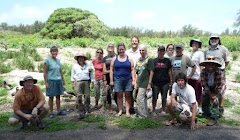
I’m still saturated in salt from this morning. My hair is deliciously knotted into bunches from today’s perfect sequence of events. We motored out to the far side of the emergent reef and snorkeled around Reef Hotel. The corals were purple, the fishes were blue, and the rusty rubbish was everywhere as always. I wanted to stay longer. I wanted to wander the whole atoll, circumnavigate it with my eyes underwater. But we had work to do. Or Kate did anyway. She’s a researcher from Santa Cruz looking at how marine life responds to different levels of sedimentation in various locations around the atoll.
We found our GPS location to within a few meters. The sea was choppy, even inside the atoll. Darius, Terry, and Ann jumped in with Kate and dove down to sample the sea floor. Karen and I stayed onboard and got a little seasick in the rough swells. Our anchor got stuck as we tried to leave, but we survived. Then we motored out of Wells’ Harbor, the atoll’s natural opening. Outside the reef, the waves were 3-5 feet swells, crashing hard into the emergent reef. We must have been going 30 knots, slapping the water with our bow. It was rough and wet. We came back past Sand Island and zoomed out the artificial south channel to see Eastern Island, the rusty barge and more birds feeding on the water. When our spines were sufficiently compressed, we returned for lunch.
photo credit: Dani Carter
Friday, June 19, 2009
Midway Day 5 - Snorkeling: by Carlie Wiener
The Many Shades of Midway
The many shades of Midway awaken the senses, never before have you seen so many hues of blue. Underwater the vibrant colors jump out at the eyes, flashes of greens, oranges and pinks swim by as fish dart between the corals. Crystal clear waters gently lap the reef crests displaying the pristine reefs. Lace coral decorates the ocean floor along with huge sea cucumbers and bright red pencil urchins. The eager faces of the participants show the excitement which they can not contain.
Today, the group was treated with the unique opportunity to swim in one of the last predator dominated ecosystems. Awestruck and intimidated by the vastness of turquoise blue waters, participants rode the U.S. Fish and Wildlife boat to our snorkel destination, Hotel Reef. The group could not wait to enter the water, excited by the chance to swim in the middle of an old volcano. Swimming in the surprisingly cool Monument waters the group swam the perimeter of the reef watching brightly colored uhu (parrot fish), mimicking the swift movements of the giant ulua (blue fin trevally) and admiring the healthy coral. Excited to share their snorkeling experiences, the group exchanged stories back on the boat and looked up the fish they saw in the ID books. Today’s snorkel excursion was just one of the many amazing activities offered this week. Teresia Teaiwa in Epeli Hau̒ofa ‘s We Are The Ocean quotes “We sweat and cry salt water, so we know that the ocean is really in our blood”.


photo credits: Carlie Wiener
The many shades of Midway awaken the senses, never before have you seen so many hues of blue. Underwater the vibrant colors jump out at the eyes, flashes of greens, oranges and pinks swim by as fish dart between the corals. Crystal clear waters gently lap the reef crests displaying the pristine reefs. Lace coral decorates the ocean floor along with huge sea cucumbers and bright red pencil urchins. The eager faces of the participants show the excitement which they can not contain.Today, the group was treated with the unique opportunity to swim in one of the last predator dominated ecosystems. Awestruck and intimidated by the vastness of turquoise blue waters, participants rode the U.S. Fish and Wildlife boat to our snorkel destination, Hotel Reef. The group could not wait to enter the water, excited by the chance to swim in the middle of an old volcano. Swimming in the surprisingly cool Monument waters the group swam the perimeter of the reef watching brightly colored uhu (parrot fish), mimicking the swift movements of the giant ulua (blue fin trevally) and admiring the healthy coral. Excited to share their snorkeling experiences, the group exchanged stories back on the boat and looked up the fish they saw in the ID books. Today’s snorkel excursion was just one of the many amazing activities offered this week. Teresia Teaiwa in Epeli Hau̒ofa ‘s We Are The Ocean quotes “We sweat and cry salt water, so we know that the ocean is really in our blood”.
photo credits: Carlie Wiener
Midway Day 4 - Invasive Plants: by Terry Reveira
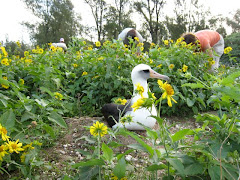
Today we met Greg Schubert and he talked to us about invasive plant species and how they are trying to control them here. The one we learned about and will be doing a project with is the Verbacina. It is has a pretty yellow flower like a daisy and looks like a bush. It grows very quickly and takes over an area in a few months. The good thing is it can be removed easily because it has a shallow root system so you just yank it out of the ground. A problem that occurs is after you remove it the seeds in the ground begin to grow as soon as there is rain, so you have to remove it before it seeds or during and then continue to weed the area for regrowth. You also have to plant another plant to take over the area. We planted a native grass - about 400 plants! It was great. Everyone was pulling up plants, piling them up, then planting the new grass plant. We could really see a big difference in the area!
photo credit: Dani CarterWednesday, June 17, 2009
Midway Day 4 - Monk Seals: by Meghan Marrero
On Saturday, while taking in the Midway sights—pristine azure water, fine white sand, impossibly blue sky—a Hawaiian Monk Seal and her pup came cruising toward us, parallel to the shoreline. As the pair got closer, they lifted up their heads, curiously spying on us, and then began swimming closer and closer. Eventually, they got so near to us that we had to scurry up the beach to keep the requisite distance of 150 ft!
Unfortunately, not all seal encounters are this friendly. Hawaiian Monk Seals are one of the most endangered seals in the world, with approximately 1100-1200 individuals remaining, and a declining population. Their Hawaiian name, “’Ilio holoi ka uaua,” literally means, “the dog that runs in the rough (seas).” Most of the threats to these beautiful native animals are human, including entanglement in ghost nets, hooking by fish hooks, and habitat disturbance. When humans encounter these animals, they may not realize the importance of keeping their distance so that the seals can get their much needed rest on the beach.
During today’s seal module, PAA participants met with scientists Brenda Becker and Krista Graham, who introduced us to Hawaiian Monk Seal life history and some of the important research projects that they and other scientists are conducting. We then got to watch the team place a flipper tag on a newly weaned Monk Seal pup. These tags, along with photographs, allow scientists to identify individual seals and track them through adulthood, at least 25-30 years.
If you do happen to encounter these or other seals on your local beach, be sure to keep the following ‘rules’ in mind:
• Enjoy them from a distance, at least 150 feet
• Do not disturb them
• Keep dogs and other animals away from them
• Clean up after your pets—feces can carry disease
• Pick up your garbage and do not litter—most marine debris comes from land!
Photo credits: Meghan Marrero
Unfortunately, not all seal encounters are this friendly. Hawaiian Monk Seals are one of the most endangered seals in the world, with approximately 1100-1200 individuals remaining, and a declining population. Their Hawaiian name, “’Ilio holoi ka uaua,” literally means, “the dog that runs in the rough (seas).” Most of the threats to these beautiful native animals are human, including entanglement in ghost nets, hooking by fish hooks, and habitat disturbance. When humans encounter these animals, they may not realize the importance of keeping their distance so that the seals can get their much needed rest on the beach.
During today’s seal module, PAA participants met with scientists Brenda Becker and Krista Graham, who introduced us to Hawaiian Monk Seal life history and some of the important research projects that they and other scientists are conducting. We then got to watch the team place a flipper tag on a newly weaned Monk Seal pup. These tags, along with photographs, allow scientists to identify individual seals and track them through adulthood, at least 25-30 years.If you do happen to encounter these or other seals on your local beach, be sure to keep the following ‘rules’ in mind:
• Enjoy them from a distance, at least 150 feet
• Do not disturb them
• Keep dogs and other animals away from them
• Clean up after your pets—feces can carry disease
• Pick up your garbage and do not litter—most marine debris comes from land!
Photo credits: Meghan Marrero
Kaneloa
The Voyager’s Dream
By Walterbea Aldeguer
June 16, 2009, 2:23 A.M.
Charlie Barracks, Midway
Look where the dream has taken me, oh sweet kupuna kane
Westward to the far reaches of the sun to Pihe Manu
Your head touched the sky
The horizon only knee deep
You said follow me and
I replied, “But I am not a strong swimmer.”
You smiled and said to me,
“Overcome the fear and you will understand. Follow me.”
O sweet kupuna kane, how I love your teachings of the night
O sweet Kaneloa, the voyager and revealer of dreams.
Tuesday, June 16, 2009
Midway Day 3 - Fish Hooks: by Sunny Seal-LaPlante
Terry Riviera from the Big Island had wooden fish hook shapes and kukui nuts for us to work with as a craft, to learn about how fish hooks were made, some of the uses for the kukui, and the story of Maui.
Some of the fish hooks were made in two pieces so that if the fish was so strong to take the hook only half of it would break off. For opelu fish hooks were made from shiny shells as they are attracted to that. The kukui tree is a common plant brought by the Polynesians as the nuts are used for lighting. Strung on a midrib the nuts are so oily they burn like mini-torches. Kukui also has the word meaning of “enlightenment.”
So we as a group spent a good hour using coral and sandpaper to smooth our fishhooks or kukui nuts, then using Kukui nutmeat to oil up our wood and braiding or twisting cordage to make the part that goes around our necks. Each one of us had some success.
Meanwhile we heard about Maui the demi-god whose fish hook still hangs in the night sky- the constellation of Scorpius, and how his Grandmother told him a chant for his fishhook so that it could catch anything. Then he and his brothers went out fishing and snagged the islands. He told his brothers “Don’t look back!” and “keep paddling, paddle harder!” He was pulling up the Northwest Hawaiian Islands, but then one of the brothers looked back and then the islands couldn’t be pulled up any higher. Stories about Maui are known through out the Pacific. There is one about how he tricked the Alae bird into giving fire to man. On the Waianae side of Oahu there is a silhouette of Maui most visible in the early morning.
And so went that part of our afternoon with arts and culture, storytelling and hands-on activities.
Photo credit: Dani Carter
Some of the fish hooks were made in two pieces so that if the fish was so strong to take the hook only half of it would break off. For opelu fish hooks were made from shiny shells as they are attracted to that. The kukui tree is a common plant brought by the Polynesians as the nuts are used for lighting. Strung on a midrib the nuts are so oily they burn like mini-torches. Kukui also has the word meaning of “enlightenment.”
So we as a group spent a good hour using coral and sandpaper to smooth our fishhooks or kukui nuts, then using Kukui nutmeat to oil up our wood and braiding or twisting cordage to make the part that goes around our necks. Each one of us had some success.Meanwhile we heard about Maui the demi-god whose fish hook still hangs in the night sky- the constellation of Scorpius, and how his Grandmother told him a chant for his fishhook so that it could catch anything. Then he and his brothers went out fishing and snagged the islands. He told his brothers “Don’t look back!” and “keep paddling, paddle harder!” He was pulling up the Northwest Hawaiian Islands, but then one of the brothers looked back and then the islands couldn’t be pulled up any higher. Stories about Maui are known through out the Pacific. There is one about how he tricked the Alae bird into giving fire to man. On the Waianae side of Oahu there is a silhouette of Maui most visible in the early morning.
And so went that part of our afternoon with arts and culture, storytelling and hands-on activities.
Photo credit: Dani Carter
Midway Day 3 - Sustainability: by Kathy Knoeppel
It’s Monday on Sand Island in the Midway Atoll. As part of learning about the Hawaiian culture we have been learning Hawaiian words. Two words that we learned today are malama – to take care of and kuleana – responsibility. I thought about these words as we visited the islands hydroponics greenhouse, the power plant and the water purification plant.As Tracy and Matt, our U.S. Fish & Wildlife guides, talked they impressed upon us the importance of the island being self-sustaining. For instance, at the hydroponics greenhouse, we were told that the amount of vegetables grown using this system saved the cost of one transport flight to the island. This was equivalent to the salary of the hydroponics person’s for a year—not to mention the bonus of the fresh veggies we have been able to enjoy.
The idea of sustainability is lived every day at Midway. I like the quote that we learned about earlier this week where an 8th grader defined sustainability as “enough for everyone, everywhere; forever”. Sustainability as I saw from the hydroponics greenhouse does not come from want but from abundance.
photo credit: Dani Carter
Midway Day 3 - Albatross: by Jeff Manker

Call of the Albatross
Besides being surrounded by thousands of miles of ocean, the most significant natural phenomenon on this island are the albatross. You cannot go anywhere or e
ven look out a window without encountering them. The sleek, smooth-feathered adults with their smoky eyes and regal posture to the gawky, fuzzy-headed or Mohawked youngsters scattered across acres and acres as they patiently await the next incoming flight of food.Today John Klavitter, the refuge biologist, gave us a primer on the three species of albatross. An unfortunate side of his talk had to do with marine debris. Twenty tons of plastic accidentally arrives on the island every year. Twenty tons! Twenty-two percent of that is identifiable as coming from land sources, eighteen percent from ocean sources and the remaining sixty percent’s source is unidentifiable. He told us that fifty-five percent of the terrestrial plastic was bottle caps. With a few quick calculations I came up with 4850 lbs of bottle caps coming to this island per year! I don’t think it would be an exaggeration to say that at least half of those (probably more than a ton) are being fed to albatross chicks.
I am committed to make a difference in stopping this unnecessary deluge.
Midway Day 2: by Miriam Sutton
Midway History Tour
A home isn’t a home until you know its history; whether that history be happy, sad, trivial, or monumental. We headed out on our bikes for a historical island tour of the island, led by Tracy Ammerman (U.S. Fish and Wildlife Service). In 1903, the Commercial Pacific Cable Company (building shown at left) became the first guardians of the island after President Roosevelt placed the US Navy in charge to prevent poachers from devastating the wildlife for eggs and feathers. (The eggs were harvested for their albumen, used in photography).
PanAm Airlines brought the first visitors to Midway in 1935 to enjoy 4-star accommodations (built by PanAm). The historical event Midway is most noted for is the Battle of Midway which took place June 4 - 6, 1942. Midway’s first encounter with war actually occurred on December 7, 1941 (Pearl Harbor Day) when Japanese ships opened fire on the island about 12 hours after attacking Pearl Harbor. The Command Post and other Midway facilities, were hit. Six months later, the Battle of Midway became a critical battle in the Pacific and provided a turning point for the war. At one time, 5000 residents called Midway their home.
Most of the buildings constructed in 1903 lie in ruin today. Many of the buildings constructed during the military occupation in 1941 are still standing and have been renovated for use by the current residents (70 people) of Midway. The wildlife of Midway continues to utilize the abandoned buildings and grounds for nesting areas. It amazes me to observe how many of the birds have adapted to the anthropogenic impacts on the island. Some of them have even managed to find a use for marine debris that has washed ashore.
Sunday, June 14, 2009
Reflections on the first day at Midway: Saturday, June 13th
Activities for the first day on Midway included a Scavenger Hunt to allow participants to explore and get oriented on Midway, as well as an evening session, led by participant Karen Matsumoto, on Nature Journaling. The following are everyone's favorite (or "wow") moments of the day:
Anne – seeing the Fairy Terns hover close overhead
Sunny – seeing all the sea turtles
Meg and Carlie – having to move off the beach when a Hawaiian Monk Seal and her pup came ashore nearby
Darius – swimming/snorkeling at the Pier and overcoming many stereotypes of animal-human interaction (i.e. not fearing the sharks that he saw)
Karen and Ron – having the plastics issue really sink in when seeing a dead Albatross chick full of plastics; and being awed watching Jeff make a lesson of it on video for his school kids
Kathy – breaking the dead Albatross chick’s wishbone with Ron and both wishing for “no more plastics”
Miriam – being wowed by not having the words to describe her experiences so far
Terry – seeing a line of Black-footed Albatross stretching and flapping their wings
Trevor – being surprised to learn about and see the amount of human impact and development on the island, and thus appreciating the restoration efforts that have occurred here (and witnessing the results of those efforts) all the more
Jeff – seeing the beauty of the Red-tailed Tropicbird
Dani – having the unexpected joy of getting lost in the forest during the scavenger hunt with her teammates (it is also a wow moment, as in “wow, how are we all this bad at reading a map?”)
Ann – seeing two Laysan Ducks trying to get into the Visitors Center (she would have never imagined, 10 yrs ago, not having to search for them!)
Walterbea – having several special encounters with a Fairy Tern, including singing Aloha Moki Hana and Lei Mamo to it.
Subscribe to:
Posts (Atom)