Welcome to the PAA Blog

Papahānaumokuākea 'Ahahui Alaka'i (PAA) is a ten-day experiential leadership program that brings together teachers, business people, policy-makers as well as potential community leaders interested in learning and being inspired by science and traditional knowledge management practices. Papahānaumokuākea Marine National Monument encompasses roughly 140,000 square miles of the Pacific Ocean, an area larger than all the country's national parks combined. The area around the Northwestern Hawaiian Islands is an important safe haven for wildlife such as the threatened green turtle and the endangered Hawaiian monk seal. ‘Ahahu‘i refers to society, club or association. Alaka’i is Hawaiian for ambassador or leader. The Hawaiian word /acronym PA‘A means steadfast, learned, determined, strong, to hold, keep, retain.

Tuesday, June 30, 2009

Reflections: Anne Rosa

The participants of the PA'A program call many areas their home. The strength of this group was making ties between the kupuna islands and each of our homes. My way of bringing my experiences in Papahānaumokuākea home are to talk about the “two oceans” that I swim in. One is in our younger Hawaiian Islands at Hanauma, and one is in our Kupuna islands at Pihemanu(Midway).

Aloha ke kai o Pihemanu
Aloha ke kai o Hanauma

Noho nā kūpuna i ke kai o Pihemanu

Noho nā keiki i ke kai o Hanauma

The keiki travels to meet the Kupuna

Honi kaua, a greeting is exchanged

Piha me ka mahalo, filled with grattitude

Nunui nā i'a kupuna o Pihemanu

Pehea ho'i nā i'a kupuna ia Hawai'i?

Piha na manu i ke kai o Pihemanu
Pehea ho'i na manu i ke kai o Hanauma?
A pehea ka make 'opala?

A pehea ka huli aniau?
Ke ho'i au me ka hana nui

Ke ho'i au me ke aloha nui

Aloha nā kai o nā keiki

Aloha nā kai o nā kūpuna

Papahānaumokuākea is a conservation area where fewer people go, Hanauma is a conservation area where many people go. I talk about my love for both places. I compare Hanauma and the younger Hawaiian islands at the place of the young, the keiki, and Papahānaumokuākea as the place of the kūpuna, the elders. I traveled to the place of the kūpuna. I was humbled by this place and greatful to be there. I was inspired by the return of life to Midway, how the marine life can thrive, how the birds have come back. Seeing the abundance of bird life at Midway made me wonder if more seabirds could return to Hanauma. Hanauma is a good place for the keiki, the young marine life are sheltered here. There is a challenge for us to have more protection throughout our Hawaiian waters so that we don't loose too many of the i'a kupuna, the large old fish that help to keep the stocks going. Other challenges come in the form of global problems like climate change and marine debris. How do we avoid death by plastic? How can we lessen our contribution to climate change? As an educator at a marine protected area my role is to share information with people on how they can help to make a difference and protect these special places in the ocean. I return from this journey with new energy, knowledge and inspiration to do my part.

photo credits: Anne Rosa

Reflections: Meghan Marrero

The morning after arriving home in New York, I woke to the sounds of bird chirping. I’m sure they do that every morning, but I don’t think I had noticed before—birds just weren’t my thing. Hearing the feathered friends outside my apartment transported me back to Midway, where I had fallen in love with the thousands of albatross chicks within sight of my window at Charlie Barracks, and the little pairs of highly endangered Laysan ducks waddling by.

My experience at Midway will not easily be forgotten. I even have my own battle scar—12 stitches will leave a mark! I learned so much in so many different areas including science, history, and culture. Who knew that short-tailed albatross flirt with decoys, or that an ecosystem can be dominated by apex predators? I fell in love with the albatross chicks as I got to know those that sat in the way of my daily travels, the first time in my memory that I have demonstrated even a remote interest in birds. I profoundly appreciated the presence of so much World War II history, and imagined the young men who sat in the middle of the Pacific, understanding the gravity of their mission while shaking in their boots and hearing terns and bombs shriek overhead. I also felt the tug of the spiritual and cultural connection. Understanding the importance of the kupuna islands makes Midway even more special.

As PAA participants, it is our kuleana to remember this place, to reflect on our journey, and to pay it forward so that the lessons of Midway will be far-reaching.

Reflections: Miriam Sutton

PA’A: “steadfast, learned, determined, strong, to hold, keep, retain.”

I walked along the paths with the albatross once more today and even made an attempt to teach them about their parents’ journeys out to sea. It is hard to imagine what tomorrow morning will be like without waking up to albatross calls at dawn or hearing the puttering of their feet just before take-off or ducking to avoid a collision with an adult returning from a 2-week, 2000+ mile journey to the Arctic. I will surely miss those encounters.

Our PA’A project presentations were completed today and most of our afternoon was free for us to enjoy Midway. After a final snorkel at the cargo pier, I biked around the island for one more chance to absorb as much as I could from the wildlife and the aura of PA’A that engulfs Midway. I met so many wonderful people this week who were devoted to making our experience at the Midway Wildlife Refuge unique and memorable. To each of them, I am truly grateful. I have many new friends who I will carry forward in my heart as I work to implement my PA’A project back home.

Things I will miss when I leave Midway: monk seals and sea turtles hauling out onto the shore to warm themselves in the hot sand and sun; watching the albatross surf the waves on the south shore of Sand Island; and watching the albatross chicks practicing for flight with all the awkwardness of a teenager trying to manage gangly growth spurts.

What I will not miss when I leave Midway is the plastic-filled stomachs of dead chicks or the mournful cries of the adults as they search for their chick who died while the parents were out to sea foraging for food.

Things I will take with me when I leave Midway: a deeper understanding of the factors that affect the wildlife struggling to survive among the Northwestern Hawaiian Islands; the support of my PA’A ‘ohana (family); and the compassion of the scientists and volunteers who live and work on this remote island in the middle of the Pacific Ocean. I take with me “PA’A,” to guide my thoughts and actions with my students as we work within our community to monitor and conserve our pristine estuarine environment.

Mahalo! (Thanks!)
photo credits: Miriam Sutton

Reflections: Trevor Atkins

Final Reflection – Rusty Bucket, Sand Island, Midway Atoll

I sit here with much in front of me. A vine of pohuehue creeps out from my feet toward the water, wishing to swallow the rusty mess of gears and axles that constitute the coastline. An albatross chick preens and sleeps on the sand, away from her nest, perhaps premeditating a great sea voyage of many years that could begin tomorrow. A monk seal finds peace, like me, in the protection afforded by this massive ring of coral reef that surrounds us all. We are ants clinging to the tip of a sinking rockberg. The sea would like to gulp our little islands and extinguish our existence, but we humans will probably kill ourselves and the seals before the seas transgress.

Midway is an end – and island’s last dying breath before sinking out of the terrestrial world
Midway is a beginning – a place where the banished creatures have come to hide from men
Midway is an end – a battlefield of war and a graveyard of heavy metal corpses, toxins, and lead
Midway is a beginning – a place where America wants to give nature a second chance
Midway is an end – a five-mile wide collection dump for the world’s plastics
Midway is a beginning – a haven for Laysan ducks and noddies and terns and albatross to procreate
Midway is an end – a last stop off for our dying tropical species before they leave forever
Midway is a middle – a middleplace to give the world hope, to bring continents together in global efforts to save one of the last beautiful places; a middletime between our ugly (and beautiful pasts) and our ugly (and beautiful) futures; and tonight, Midway is the middle of the world

Reflections: Sunny Seal-LaPlante

Ah Midway, what can I say? What impressed me most was the wildlife. The white terns who fly so close to my head, the Laysan albatross chicks that wait patiently “cooling their heels” in the hot sun, the parents who fly in for such a short time to feed their ‘one and only” which they have found amidst all the others, they feed their chick and then right back out to sea two parents sharing the responsibility.

Red-tailed tropic birds, why are you declining? You have the cutest babies with halo fluff. And Laysan ducks happy in puddles or sitting on whale bones need assistance to continue to increase their population. And I haven’t yet mentioned the great frigate birds, the black footed albatross, Bulwers petrels and so many others. Monk seals especially the young are playful, entanglement a problem for them.

Then there is the sea, its indescribable beauty coloring the clouds green and being a foil for white bird portraits. Under that turquoise and azure color is a predator dominated ecosystem, meaning plenty of large uluas and sharks! Seeing nudibranch for the first time and being where the animals studied me as much as I looked at them was novel. And yes on the beaches and shores was a large amount of plastic which compels me to do even more about it. And the albatross chicks that have died from ingesting too much plastic is heartbreaking and a grim warning for humans who are filling the ocean food chains with plastic. No, you didn’t mean to and I didn’t mean to, but plastic is everywhere, getting into the ocean food chains, breaking into small pieces and becoming more numerous than plankton in some parts of the ocean. So fish and marine life are more likely to eat plastic than food. Now that you know, what will you do?

This is now our kuleana, our privilege and responsibility to do something and for those reading this I give it also to you.
photo credit: Sunny Seal-LaPlante

Reflections: Carlie Wiener

Perceptions of time are non-existent at Midway Atoll, a healthier sense of awareness lives. Rising with the sun and surrendering your schedule to that of the birds. This week, has passed so quickly but I could not even begin to describe how much I have learned. The quiet is filled with the calls of so many different birds, ones that I now recognize. Each albatross taking on its own identity, like a proud mother I am excited about the fledgling’s progress. They spread their wide-spanning wings for flight, their unsure take offs and uncoordinated landings, preparing them for their upcoming journey. I will forever long to hear the sound of quickened footsteps, the adult albatrosses taking flight on a make shift run way. The stark white turns hover gracefully amongst the trees, never straying far from their fluffy white chicks. The varying shades of blue in the ocean are indescribable drawing you close like a calling. I often look back just to make sure the beauty is still there, not something I must have imagined in my wildest dreams. Swimming in the cool, Pacific waters is like a reawakening. Healthy corals and fish demonstrate the importance of our reefs and protected places. This week has been a mix of feelings joy, motivation, appreciation and mostly of importance.

You can see the bonds of the group growing stronger as we build our experiences together. The energy is motivating but I fear that my abilities will not live up to the groups expectations. I want so badly to do right by the world, make a difference for the earth and the people as well. I am increasingly aware though that life has its obstacles, the pull of the everyday, the deadlines and commitments. I fear that the feelings and motivation that I hold right now will not be strong enough to overcome the day to day workings of life. The Northwestern Hawaiian Islands will always be a special place not just to me but to anyone fortunate enough to experience its power and pure natural beauty. Midway is a place of contradiction, filled with wildlife: monk seals, sharks, birds but also a keeper of the past; remnants of wartime, contaminants and indestructible waste. I fear that these too will play a part in the future of this Atoll. Not just the direct impacts which have been brought upon Midway but all the other debris and floating fishing gear that ends up on this island. Its effects reach far from the litter scattered across the shoreline, to the coral reefs, monk seals, sea birds and honu all who fear its deathly grasp. The colorful plastic lies as a reminder of how we need to change our lives and priorities. Bright and colorful its once useful and happy existence turns dark and looms forever in our environment.

For me though, the things I will take away from this experience will forever stay. The sense of belonging to a group where people have the same drive and passion. A sense of hope for the future and a reminder of why I went into this field in the first place. The passion is relit and the messages are clear. Not just for myself but for any thinking, breathing person. In order to care you must feel and in order to feel you must experience. I indeed have experienced nature at its best, it is up to me and every other person in our communities whether that be families, schools or towns, to show the beauty and importance of our natural world. Mahalo nui loa for the opportunity to share this special week and for the bonds that are now cemented for life.

Reflections: Karen Matsumoto

In this final journal entry, I want to share some of my observations of Midway. Reflecting on my recent experience, I can already see it from several different vantage points. Its meaning for me is deep and will be lasting, I am sure, but it is not a single meaning. Like everything else in life the message of this amazing time depends on where you look from and the lens you look through.

First, I feel humbled by the privilege of having been one of twelve participants in an amazing environmental leadership program in Midway Atoll. I hope to be an environmental ambassador for the NW Hawaiian Islands as a result of my experiences there. The home communities and work of all twelve participants vary widely, but our shared experience here on Midway help us to find common ground.

Sand Island on Midway Atoll fits most people’s idea of a tropical paradise. Bicycling across the island, I dodge baby albatrosses waiting for their parents to return with food. I will learn that the adult birds fly 1,200 miles every other week to the Bering Sea and points beyond. The young birds are not wary of humans. Now and then one of them will look up and clack its bill at me and I hear moaning coos or high-pitched peeps from near and far as they call out to their parents. The fledglings sit neatly spaced in fields of fragrant white fragrant flowers in roughly formed nests. The parent birds ignore humans as they feed their chicks, regurgitating the squid and other food they have foraged from distant seas. They are dedicated parents, and it is a joy to watch them with their young.

Walking down the trail, I see white terns roosting on branches and cliff ledges. They swoop and hover around me like little fairies, usually just checking me out but sometimes even landing on an outstretched hand.

Further down the trail thousands of yellow sunflowers bloom in the fields with their rich green foliage, a gorgeous contrast of color against the clear blue sky. These fields of sunflowers outline the sand hills of the northernmost part of the island. More albatross fledglings and other sea birds sit among the plants waiting for their parents to return.

Going down to the beach, I stoop to pick up some colorful striped cone shells, and the tiniest chubby sand dollar I’ve ever seen, bleached white like the coral sand. Walking down the smooth, peaceful stretch of sandy beach, I spot a monk seal sunning in the sand with its sleepy pup. A honu, or green sea turtle, basks on a large rock nearby.

Walking back from the beach through a forest of trees that look like some kind of pine, the branches are dotted with more tiny white terns. There is a peaceful-looking cemetery nearby, the old headstones a memorial to island residents otherwise unremembered.

I later learn that the island has been an important site for religious and ceremonial purposes for centuries by early native Hawaiians. More recently around the middle of the 20th century, buildings designed by the renowned industrial architect Albert Kahn were constructed here. The clean lines and distinct design features of the buildings remind me of Frank Lloyd Wright. It wasn’t that long ago this island was a bustling community, built with care and serving important purposes.

Roads criss-cross the island and the old airstrips built by the U.S. military during WWII are still here. Many of the albatross nesting grounds are alongside and even on the roads. Albatross babies sit on manhole covers their parents chose as nesting places. Many wait in less developed areas that have been taken over by invasive non-native plants, and some sit among fields of Alyssum plants that were introduced to keep down noxious weeds and provide groundcover.

The ground around the nesting areas is strewn with bits of plastic garbage: cigarette lighters, bits of fishing line, lego blocks, toothbrushes, bottle caps, and pieces of plastic of all colors, shapes, and sizes. These have been brought back by the parents mixed with the squid and fish eggs collected to feed their young. Floating in the sea, they were first swallowed by the parents, then regurgitated and swallowed by the growing babies along with food. Albatrosses cough up indigestible parts of their diets such as squid beaks and eyeballs – and all kinds of plastic debris - as boluses similar to owl pellets. The organic components of the boluses eventually decompose, leaving the plastic bits on the ground. Here and there I come across a decomposed albatross carcass and I can see the mass of plastic debris that filled its stomach.

The lovely yellow sunflowers that cover much of the island are Verbesina encelioides or golden crown-beard, an invasive weed that can quickly choke out all native vegetation. The thick foliage of Verbesina, up to four feet tall and dense enough to block cooling breezes from the sea, can create stagnant “dead zones” where it can be ten degrees hotter than surrounding areas. Many fledglings, whose instinct is to stay where their parents leave them, die here with no escape from the heat. Thickets of verbesina can also make it difficult for parents to find their babies, and for other ground-nesting or burrowing birds to find a place to nest.

On the sand around the monk seals on the beach are plastic buoys, colorful laundry hampers, and tangled piles of rope. A monk seal pup playfully investigates a plastic jug washed up on the shore. The honu’s basking place is actually a concrete boat ramp strewn with plastic marine debris.

The pine-like forest is made up of ironwood trees from Australia, another non-native species that has replaced naupaka and other kinds of native shrubby vegetation. Albatross and other birds have trouble flying around and among these trees and often crash into them and die. In this area Verbesina and ironwood have also taken over precious habitat for ground-nesting birds.

The historic Kahn-designed buildings, as well as many of the former shops and maintenance sheds on the island, are in varying stages of decay and disrepair. Many of the white terns use crumbling windows sills as nesting “cliffs”. Falling roofs and eroding walls are hazards to people and animals. I see young birds standing listlessly, unable to hold their wings up off the ground, the effects of poisoning from eating lead paint chips.

I learn that the peaceful cemetery we observed had gravestones marking the final resting place of several key American military doctors and others whose lives were lost during World War II. Most Americans, if they recognize the name “Midway” at all, know it only as the site of a battle considered an important turning point in the Pacific war. In June of 1942 four Japanese aircraft carriers and a heavy cruiser were sunk in exchange for one American aircraft carrier and a destroyer. Over 300 Americans and more than 3,000 Japanese soldiers lost their lives in this battle.

As I write this I feel heaviness in my heart and a deep sense of tension between these two views of the beautiful island. It is an idyllic tropical paradise and at the same time, it is also an example of an ecological disaster caused by the thoughtless development of our throw-away society and the narrow purposes of the military. But these two views alone do not encompass the whole story of Midway.

In many parts of the world there is growing concern and organized action to undo the effects of ocean pollution and the many threats to wildlife. On Midway itself I have participated over the past days in active efforts led by dedicated refuge staff to save endangered wildlife and restore badly needed habitat. While the effects of environmental degradation caused by historic human impacts are still obvious, now I can also see where people have begun to make a difference.

I know now that the Laysan duck, monk seal, and green sea turtle populations are rebounding from near extinction, due to efforts of dedicated researchers and wildlife managers. Thanks to an enormous effort by the military, the accidentally introduced black rat was finally eradicated in 1997, allowing small ground nesting species such as the Bonin petrel to make a comeback on the island.

The Verbesina that once covered most of the island has been cleared from large areas through the dedication and tremendous efforts of refuge staff and volunteers. Native bunchgrasses are taking root, providing shade and cover for ground nesting birds. These grasses were raised in greenhouses and carefully planted by hand. A management plan has been drafted that will guide the removal of many of the ironwood trees, and their replacement with native shrubs and tree species.

An enormous quantity of non-native soil was brought to the island in past years, making the island no longer a totally natural area, but people are working hard to repair the damage caused by past “standard” practices, and are making increasing efforts to integrate nature with human occupancy and use. Having spent a few days on Midway I can now see the results of restoration efforts all over the island: rehabilitation of natural seeps, invasive plant control, historic building restoration, and marine debris clean-up.

There are even plans to restore many of the old Albert Kahn buildings on the island. Many of the salvageable buildings are currently being renovated for use as housing and offices for year-round residents of Sand Island. There are extraordinary efforts underway to make habitation on the island sustainable. Hydoponic gardens supply many kinds of fresh produce for islanders and strategies to save energy and water in line with sustainable practices are happening now.

The most important message I took with me when I left Midway was that natural world here has endured through years of changing uses: from a communications depot, an important military installation, and finally a wildlife refuge of global significance. Scientists, educators, and visitors to this special place are spreading the word on marine debris and its impact on the ecosystem. Conservation groups such as the Surfrider Foundation and World Wildlife Fund are helping in this effort.

These and many other efforts are starting to link up worldwide, leading to a growing sense of questioning the purposes and methods of a culture based on disposable products. For the first time since the plastic boom that began in the 1950s, people are beginning to see that we can’t go on this way, as the truth on plastics is reaching the general public. Cities in Ireland, Australia, and China have already banned one time use plastic bags, and the UN is now calling for a global ban. I have been a lifelong conservationist and supporter of environmental causes, but it was not until my trip to Midway that I really became fully conscious of the consequences of my unexamined consumer habits, especially my use of one-time use plastic products.

When I feel as if the glass is half full, I think of Midway and the loveliness of a tropical island paradise with abundant sea bird populations and clear blue ocean waters. When it seems the glass is half empty, I see a trash-strewn and weed-infested island, where coral, birds, seals, and sea turtles have an uphill battle to fight extinction. But what is really happening is that people - seeing Midway through the lens of hope supported by inspired action – are devoting themselves to the painstaking effort of restoring this beautiful place to keep the legacy of the refuge alive for future generations. Like ripples on a pond, this message is continuing to travel across the world. Now that I have experienced and fallen in love with Midway, I know this is the direction we must travel together.

With aloha and kuleana,

Karen Matsumoto deChadenedes

Saturday, June 27, 2009

A Message from Ron: Nichol and Fred

Photo credit: Ron Hirschi

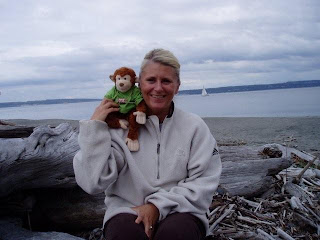
When I was on Midway, I learned that our daughter, Nichol, had been hospitalized with a serious condition......This was not easy as a Father. But home now, Nichol is doing better and has been sent many kind words from PAA Ohana. Here she is on Marrowstone Island with Fred. Fred is a monkey who kinda stole everyone's heart on our journey. He messed up a Kindergarten Classroom last year and will continue to travel with me to share our work with kids in a fun and postive way. Fred wears a band from a Papahanaumokuakea Albatross and talks story with the best of monkeys. Look for him and his sister, Coco wherever you travel.
Ron Hirschi, Marrowstone Island, Washington

PAA Last Will poem: by Carlie Wiener

To the PAA group on your final day
This last will and testament will be my final say.
This trip has been amazing and oh so much fun,
And we’re all going back 20 pounds heavier, our gluttony is done.
Where will we go at 4:30 next week?
Captain Brooks will be far away and the boluses with squid beaks.
So with this farewell, here we go,
What I leave to you based on what I have gotten to know...

To Annie a song for the world to hear,
And to Terry some fish nets making traditional Hawaiian gear.

To Darius, well um what can I say?
Dessert perhaps, with your plate of whip cream everyday.

To Jeff we wish we could leave you here,
To become one with the albatrosses and soar far and near.

And to your partner in crime, yes Ron that is you.
Swimming with the fish and then we will ID you too.
And while you’re at sea being one with the fish,
We will send you a postcard with our environmental wish.

A ray of sunshine our Sunny is,
And for you dear Sunny we leave you a green harvest biz.
With all the room on the Hilo side,
We will take the profits sand make you our monk seal guide.

And Karen, wow have you stopped smiling yet?
Your positive energy is not easily met.
And for you, well what do we give?
A journal for your amazing work and a marine debris sieve.

And Miriam our triathlon champ,
A jar of peanut butter for snacks while at camp.

Kathy my roommate with your energy and heart,
To you I give an alarm clock that never really starts.

Trevor kept the kokua the whole trip through,
And we should leave him a life jacket for when he goes overboard too.

Now Meg how about a pair of walking shoes?
Your falling fate would not make the Midway news.

And now for the facilitators, where would we be without you?
Well how about lets start with the biggest mahalo for all that you do.

To Dani, we leave your interviews done,
So you can get on with it and have some fun.
We also leave you any Midway sport,
From darts to bowling she’s the best in the court.

To Linda we leave you a funny hat,
And an official schedule with no changes, how about that?

To Anne we leave lots of string to perfect your braiding arts,
And find your wow moment in tiny sand dollar parts.

Walter Bea is next with her patience and smile,
I promise one day our E Ho Mai will get some real style.

And last but not least Tracy our faithful guide,
To you we leave a day off to enjoy the outside.

And so this concludes the PAA Last Will.
I can't believe its over, I really have the chills.
I will miss this group and the inspiration they provide,
We are now connected tested, trued and tried.
So please remember each other in the projects that you do,
And our time at Midway this special place and our friends here too.
Although you won't get to sort through carcasses everyday,
The messages you bring home will be the inspiring way.
And to you all I bid a safe trip home,
To release your environmental ethics under the education dome.
And once more a mahalo to the Midway staff team,
For you really all made our whole group beam.

Midway Day 7 - Culture and Science: by Karen Matsumoto

Ron started off with a “Guess how many spines on an urchin” guessing game, based on a question asked by one of his Ohio Kindergarten students. Terry came closest with 275! Ron reminded us that the total number of spines really depends on the species of urchin.

We continued to learn about the cultural connections of first peoples in Hawai’i and the places we live. Ron specifically pointed out the traditional hunting and fishing grounds of Olympic Peninsula in Washington that were guaranteed by the Point-No-Point Treaty of 1856. The traditional subsistence fishing and hunting areas went from the coastline to the sea, similar to the Ahupua’a land divisions in Hawaii that were based on sustainable units that include fresh water, beach access, and ocean waters.

Terry helped us to learn traditional learning pedagogies that included the use of riddles and song! We all tried our hand at composing riddles about the things we have seen and experienced on Midway. Here’s a sample from Walterbea:

Here and there
we’re everywhere.
Without a care in the world.

Answer: marine debris

Terry also facilitated a traditional way of learning navigation without GPS or a compass. Hawaiians found their way to their destinations by making songs about the various waypoints along the way, using landmarks and stories. These were called traveling songs. We broke into groups and each made a traveling song about Midway Island.

Photo credits: Karen Matsumoto

Saturday, June 20, 2009

Midway Day 6 - Laysan Ducks: by Trevor Atkins

Birds don’t interest me. I’m not sure why, but I suppose that for every passion we have, there is something else to which we are ambivalent. My passion is plants. I was raised to love them. I grew up growing them up. I think our loves often develop when we are very young. My ambivalence is birds. I can appreciate the big ones, because I grew up with them: pueo (owl) and `io (hawk). But the rest are all the same to me: feathers, beaks, brittle bones, and little legs. I can’t see them the way Jeff sees them, the way Ron and Karen see them.

But after hearing the story of Laysan ducks from the one and only John Klavitter (Wildlife Biologist with the U.S. Fish and Wildlife Service), I can appreciate their presence here. They are one of only three native ducks/geese left in Hawai`i, along with koloa and nene. Eight other species have gone extinct and the Laysan duck was casted to be the ninth. It came one animal away from extinction!

Once found throughout the Hawaiian Archipelago, the ducks were reduced to a single colony on Laysan island: 10 males, 1 female. Huge efforts went in to habitat restoration, monitoring, and medical intervention. The population quickly flourished and Laysan was soon full to capacity with them. So, in order to diversify their distribution, researchers created new habitats on Midway. They dug a few feet down through the concrete and coral to the water table, creating wetlands from freshwater seeps, landscaped with makaloa and native bunch grass. Eventually, 21 ducks were brought in and all survived the translocation. To everyone’s surprise, the one-year old ducks reproduced offspring that spring. Each year since then, the population has doubled.

Now they face a new challenge. Avian botulism, a disease caused by toxins from warm-water bacteria, broke out in the hot summer of 2008. The disease attacks the nervous system and causes an inability for the ducks to lift their heads. Many drown. Nearly half the Midway population was lost last summer. Then, this past Saturday, as summer temperatures rose, the first case in 2009 was reported.

This afternoon, John Klavitter treated one duck with a vaccine. Meanwhile, the “dead albatross undertaker” and others are collecting albatross fledgling corpses across the island to prevent the possibility of maggots carrying the now isolated disease around the island.

I still can’t tell the difference between all these terns and noddies and shearwaters, but the Laysan duck has captured my heart.
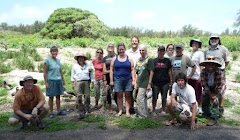
Photo credit: Dani Carter

Midway Day 6 - Eastern Island: by Ron Hirschi

Okay. It was a day of dolphins streaming past our boats, Sooty Terns, Iwa and Redfooted Boobies, and life-listing birds for Jeff….Christmas Shearwaters glistening black just above the rubble where a huge school of Aholehole linger. Gray-backed Terns at their “nests” – a simple drop upon the ground. Noddies as if painted by chocolate bars.

We were treated by Matt Brown, to the most hopeful of sites --- Short tailed Albatross decoys standing in wait. This past year a mated pair scooped out a nest bowl. Matt’s positive smile confirms: They will come back to lay eggs and raise young next year; this, one of the rarest of the rare. Then too, Matt shared with deserved pride, how the Laysan Ducks have rebounded here thanks to habitat restoration. Their pond was alive with ducks when we were honored to visit.

But now that we are back on the “Big Island of Sand”, all hearts go out to our friend and partner in this adventure, Meg who cut her knee in a fall! The entire town came out to help and wish her well when she fell. Carlie quick with the flush of water, Jeff with a first aid kit handy, and Darius the cobbler repairing the blown out flip flop. Then off island and to stitchery quick. All hands deserve many thanks and all hands give Meg a big Aloha.

We can only wish that Meg will get to take a ride with John Miller out to see the dolphins.
Photo credits: Dani Carter

Midway Day 5 - Marine Research: by Trevor Atkins

I’m warm and I’m home. Captain Charlie Barracks is my residence. Jeff, Ron, Carlie, and Dani are my family. My body is worn from adventure today. I awoke at 5:30 am and went southeast to wake the sun. I bumped along the southern shore and across the vast runway to the most desolate point on the island. The terns and shearwaters, guarding their eggs, attacked me, the ignorant intruder. I pedaled home hard and found Radio Hill as the sun peaked over the many ironwoods in Midway town. In the Radio Hill ruins I found Laysan ducks and again I felt invasive. We men are nothing but destruction. We leave no rock unturned. My bike to them is an F-16 fighter jet flying low over a small town. I’m sorry. Humans don’t deserve to see this. We only ruin it. Can anything exist without us interrogating? Can a tree fall in a forest unquestioned? Silly humans. We’ll be gone soon and the albatross will live on.

I’m still saturated in salt from this morning. My hair is deliciously knotted into bunches from today’s perfect sequence of events. We motored out to the far side of the emergent reef and snorkeled around Reef Hotel. The corals were purple, the fishes were blue, and the rusty rubbish was everywhere as always. I wanted to stay longer. I wanted to wander the whole atoll, circumnavigate it with my eyes underwater. But we had work to do. Or Kate did anyway. She’s a researcher from Santa Cruz looking at how marine life responds to different levels of sedimentation in various locations around the atoll.

We found our GPS location to within a few meters. The sea was choppy, even inside the atoll. Darius, Terry, and Ann jumped in with Kate and dove down to sample the sea floor. Karen and I stayed onboard and got a little seasick in the rough swells. Our anchor got stuck as we tried to leave, but we survived. Then we motored out of Wells’ Harbor, the atoll’s natural opening. Outside the reef, the waves were 3-5 feet swells, crashing hard into the emergent reef. We must have been going 30 knots, slapping the water with our bow. It was rough and wet. We came back past Sand Island and zoomed out the artificial south channel to see Eastern Island, the rusty barge and more birds feeding on the water. When our spines were sufficiently compressed, we returned for lunch.

photo credit: Dani Carter

Friday, June 19, 2009

Midway Day 5 - Snorkeling: by Carlie Wiener

The Many Shades of Midway

The many shades of Midway awaken the senses, never before have you seen so many hues of blue. Underwater the vibrant colors jump out at the eyes, flashes of greens, oranges and pinks swim by as fish dart between the corals. Crystal clear waters gently lap the reef crests displaying the pristine reefs. Lace coral decorates the ocean floor along with huge sea cucumbers and bright red pencil urchins. The eager faces of the participants show the excitement which they can not contain.

Today, the group was treated with the unique opportunity to swim in one of the last predator dominated ecosystems. Awestruck and intimidated by the vastness of turquoise blue waters, participants rode the U.S. Fish and Wildlife boat to our snorkel destination, Hotel Reef. The group could not wait to enter the water, excited by the chance to swim in the middle of an old volcano. Swimming in the surprisingly cool Monument waters the group swam the perimeter of the reef watching brightly colored uhu (parrot fish), mimicking the swift movements of the giant ulua (blue fin trevally) and admiring the healthy coral. Excited to share their snorkeling experiences, the group exchanged stories back on the boat and looked up the fish they saw in the ID books. Today’s snorkel excursion was just one of the many amazing activities offered this week. Teresia Teaiwa in Epeli Hau̒ofa ‘s We Are The Ocean quotes “We sweat and cry salt water, so we know that the ocean is really in our blood”.


photo credits: Carlie Wiener

Midway Day 4 - Invasive Plants: by Terry Reveira


Today we met Greg Schubert and he talked to us about invasive plant species and how they are trying to control them here. The one we learned about and will be doing a project with is the Verbacina. It is has a pretty yellow flower like a daisy and looks like a bush. It grows very quickly and takes over an area in a few months. The good thing is it can be removed easily because it has a shallow root system so you just yank it out of the ground. A problem that occurs is after you remove it the seeds in the ground begin to grow as soon as there is rain, so you have to remove it before it seeds or during and then continue to weed the area for regrowth. You also have to plant another plant to take over the area. We planted a native grass - about 400 plants! It was great. Everyone was pulling up plants, piling them up, then planting the new grass plant. We could really see a big difference in the area!

photo credit: Dani Carter