Welcome to the PAA Blog

Papahānaumokuākea 'Ahahui Alaka'i (PAA) is a ten-day experiential leadership program that brings together teachers, business people, policy-makers as well as potential community leaders interested in learning and being inspired by science and traditional knowledge management practices. Papahānaumokuākea Marine National Monument encompasses roughly 140,000 square miles of the Pacific Ocean, an area larger than all the country's national parks combined. The area around the Northwestern Hawaiian Islands is an important safe haven for wildlife such as the threatened green turtle and the endangered Hawaiian monk seal. ‘Ahahu‘i refers to society, club or association. Alaka’i is Hawaiian for ambassador or leader. The Hawaiian word /acronym PA‘A means steadfast, learned, determined, strong, to hold, keep, retain.

Tuesday, June 16, 2009

Midway Day 3 - Fish Hooks: by Sunny Seal-LaPlante

Terry Riviera from the Big Island had wooden fish hook shapes and kukui nuts for us to work with as a craft, to learn about how fish hooks were made, some of the uses for the kukui, and the story of Maui.

Some of the fish hooks were made in two pieces so that if the fish was so strong to take the hook only half of it would break off. For opelu fish hooks were made from shiny shells as they are attracted to that. The kukui tree is a common plant brought by the Polynesians as the nuts are used for lighting. Strung on a midrib the nuts are so oily they burn like mini-torches. Kukui also has the word meaning of “enlightenment.”

So we as a group spent a good hour using coral and sandpaper to smooth our fishhooks or kukui nuts, then using Kukui nutmeat to oil up our wood and braiding or twisting cordage to make the part that goes around our necks. Each one of us had some success.

Meanwhile we heard about Maui the demi-god whose fish hook still hangs in the night sky- the constellation of Scorpius, and how his Grandmother told him a chant for his fishhook so that it could catch anything. Then he and his brothers went out fishing and snagged the islands. He told his brothers “Don’t look back!” and “keep paddling, paddle harder!” He was pulling up the Northwest Hawaiian Islands, but then one of the brothers looked back and then the islands couldn’t be pulled up any higher. Stories about Maui are known through out the Pacific. There is one about how he tricked the Alae bird into giving fire to man. On the Waianae side of Oahu there is a silhouette of Maui most visible in the early morning.

And so went that part of our afternoon with arts and culture, storytelling and hands-on activities.

Photo credit: Dani Carter

Midway Day 3 - Sustainability: by Kathy Knoeppel

It’s Monday on Sand Island in the Midway Atoll. As part of learning about the Hawaiian culture we have been learning Hawaiian words. Two words that we learned today are malama – to take care of and kuleana – responsibility. I thought about these words as we visited the islands hydroponics greenhouse, the power plant and the water purification plant.

As Tracy and Matt, our U.S. Fish & Wildlife guides, talked they impressed upon us the importance of the island being self-sustaining. For instance, at the hydroponics greenhouse, we were told that the amount of vegetables grown using this system saved the cost of one transport flight to the island. This was equivalent to the salary of the hydroponics person’s for a year—not to mention the bonus of the fresh veggies we have been able to enjoy.

The idea of sustainability is lived every day at Midway. I like the quote that we learned about earlier this week where an 8th grader defined sustainability as “enough for everyone, everywhere; forever”. Sustainability as I saw from the hydroponics greenhouse does not come from want but from abundance.

photo credit: Dani Carter

Midway Day 3 - Albatross: by Jeff Manker


Call of the Albatross

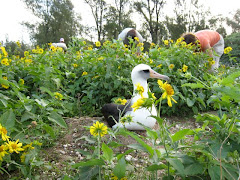
Besides being surrounded by thousands of miles of ocean, the most significant natural phenomenon on this island are the albatross. You cannot go anywhere or even look out a window without encountering them. The sleek, smooth-feathered adults with their smoky eyes and regal posture to the gawky, fuzzy-headed or Mohawked youngsters scattered across acres and acres as they patiently await the next incoming flight of food.

Today John Klavitter, the refuge biologist, gave us a primer on the three species of albatross. An unfortunate side of his talk had to do with marine debris. Twenty tons of plastic accidentally arrives on the island every year. Twenty tons! Twenty-two percent of that is identifiable as coming from land sources, eighteen percent from ocean sources and the remaining sixty percent’s source is unidentifiable. He told us that fifty-five percent of the terrestrial plastic was bottle caps. With a few quick calculations I came up with 4850 lbs of bottle caps coming to this island per year! I don’t think it would be an exaggeration to say that at least half of those (probably more than a ton) are being fed to albatross chicks.

I am committed to make a difference in stopping this unnecessary deluge.

Midway Day 2: by Miriam Sutton

Midway History Tour

A home isn’t a home until you know its history; whether that history be happy, sad, trivial, or monumental. We headed out on our bikes for a historical island tour of the island, led by Tracy Ammerman (U.S. Fish and Wildlife Service). In 1903, the Commercial Pacific Cable Company (building shown at left) became the first guardians of the island after President Roosevelt placed the US Navy in charge to prevent poachers from devastating the wildlife for eggs and feathers. (The eggs were harvested for their albumen, used in photography).

PanAm Airlines brought the first visitors to Midway in 1935 to enjoy 4-star accommodations (built by PanAm). The historical event Midway is most noted for is the Battle of Midway which took place June 4 - 6, 1942. Midway’s first encounter with war actually occurred on December 7, 1941 (Pearl Harbor Day) when Japanese ships opened fire on the island about 12 hours after attacking Pearl Harbor. The Command Post and other Midway facilities, were hit. Six months later, the Battle of
Midway became a critical battle in the Pacific and provided a turning point for the war. At one time, 5000 residents called Midway their home.

Most of the buildings constructed in 1903 lie in ruin today. Many of the buildings constructed during the military occupation in 1941 are still standing and have been renovated for use by the current residents (70 people) of Midway. The wildlife of Midway continues to utilize the abandoned buildings and grounds for nesting areas. It amazes me to observe how many of the birds have adapted to the anthropogenic impacts on the island. Some of them have even managed to find a use for marine debris that has washed ashore.

photo credits: Miriam Sutton

Sunday, June 14, 2009

Reflections on the first day at Midway: Saturday, June 13th

Activities for the first day on Midway included a Scavenger Hunt to allow participants to explore and get oriented on Midway, as well as an evening session, led by participant Karen Matsumoto, on Nature Journaling. The following are everyone's favorite (or "wow") moments of the day:

Anne – seeing the Fairy Terns hover close overhead

Sunny – seeing all the sea turtles

Meg and Carlie – having to move off the beach when a Hawaiian Monk Seal and her pup came ashore nearby

Darius – swimming/snorkeling at the Pier and overcoming many stereotypes of animal-human interaction (i.e. not fearing the sharks that he saw)

Karen and Ron – having the plastics issue really sink in when seeing a dead Albatross chick full of plastics; and being awed watching Jeff make a lesson of it on video for his school kids

Kathy – breaking the dead Albatross chick’s wishbone with Ron and both wishing for “no more plastics”

Miriam – being wowed by not having the words to describe her experiences so far

Terry – seeing a line of Black-footed Albatross stretching and flapping their wings

Trevor – being surprised to learn about and see the amount of human impact and development on the island, and thus appreciating the restoration efforts that have occurred here (and witnessing the results of those efforts) all the more

Jeff – seeing the beauty of the Red-tailed Tropicbird

Dani – having the unexpected joy of getting lost in the forest during the scavenger hunt with her teammates (it is also a wow moment, as in “wow, how are we all this bad at reading a map?”)

Ann – seeing two Laysan Ducks trying to get into the Visitors Center (she would have never imagined, 10 yrs ago, not having to search for them!)

Walterbea – having several special encounters with a Fairy Tern, including singing Aloha Moki Hana and Lei Mamo to it.

photo credit: Darius Kalvaitis

Midway Day 1: by Darius Kalvaitis

As the sun came over the lagoon, the majority of PAA participants were dreaming while a few were out and taking in the morning rays and the joy they bring from being in a magical place. When I did finally emerge from the comfort of Charlie Barracks, I found a sight before unseen by my open eyes. Got birds? The numerous birds that I had seen by headlight the previous night were now in plain view! Not just a dozen or so albatross, but more like a hundred dozen on a small lawn outside the barracks. What a sight! All the background information and photos of the Island simply had not made an impact on me like seeing, smelling and hearing firsthand.

After a marvelous breakfast the group headed to the visitors center for greetings from the park manager and basic information for our safety and comfort. It was obvious that we were amongst a community of people that both cared about us and strove to make our stay as wonderful as possible. The ground team on Midway is simply fabulous.

Having come from a more transportation-oriented background many of us were missing our “wheels”. Well, here on Midway we then received our own wheels. Except rather than the four-wheeled variety of transport that thrives on fossil fuel we received the two-wheel type that not only get us there cleanly but also help our health and happiness. Beach Cruisers in blue, silver, black and of course pink were checked out and we were off on a scavenger hunt for the larger part of the rest of the day.

As the scavenger hunt teams (groups of 3-4) departed in exploring the island from tip to tip the atmosphere of freedom ran through our veins. Some groups choose to spend some time underwater and look at fish as large as themselves while other groups investigated the marine debris inside birds that had perished and others even sang love songs to the birds. When we all did return together as a larger group the magic of the day was celebrated and shared.

Then after an evening filled with more action and nature journaling we laid down our tired bodies and stimulated minds to rest anew and prepare for the adventure and learning which we would face as the sun rose again.
photo credits: Darius Kalvaitis

Looking back on Oahu: by Miriam Sutton

Before arriving at Midway Atoll, the PAA participants spent 3 days on Oahu getting to know each other, learning about Papahānaumokuākea, and preparing for the trip. The following are excerpts from participant Miriam Sutton's blog for her school kids back in North Carolina. (http://web.me.com/msutt/AdventuresbytheSea/Blog/Blog.html ) Photo credits for the posting below: Miriam Sutton

Aia ka mo’olelo i ka ‘aina (The story is in the land)


Wednesday, June 10, 2009

The Papahānaumokuākea ‘Ahahui Alaka’i (PAA) workshop began today with a trip to the windward side of Oahu where all the PAA participants finally got a chance to meet each other and start forming our bonds for our upcoming adventure to Midway. After a brief orientation at Windward Community College, we were shuttled to Coconut Island, and the Hawai’i Institute of Marine Biology (HIMB). If you’ve seen an episode of Gilligan’s Island, you’ve seen Coconut Island. (It’s the island shown in the background during the opening credits of the show.) When we left the island today, we asked our boat captain to take us for a spin around the island. He agreed and proceeded to circumnavigate the island in about 3 minutes. Don’t let the size of this little island fool you... it is jam-packed with science and some of the highest technological equipment I’ve ever seen.

The photo of the day goes to Dr. Chuck Burrows (age 76), a retired educator who is spear-heading efforts to restore Hawai’i’s largest wetlands to its original status. Chuck introduced us to the 450-acre wetlands site with a hike and a stewardship activity designed to familiarize us with his restoration efforts to remove invasive plant species and reintroduce indigenous species.


Final Day of Preparation and Departure for Midway

Friday, June 12, 2009

Our last day in Honolulu focused on final preparations for our voyage to the Papahānaumokuākea Marine National Monument. As this week has progressed, there has been an absorption of the culture and heritage associated with the Northwestern Hawaiian Islands, and today I truly began to feel what the locals refer to as the “Aloha” spirit. Each day of the workshop began with a Hawaiian pule (prayer) asking for guidance and knowledge as we prepared for our journey to the monument. Each day, we met with policy officials and Native Hawaiians to learn about proper protocols and beliefs. Each day, we were surrounded by wise stewards who are passionate about their research and their contributions for sustaining Hawaiian history and culture for generations to come. We have been charged with their honor, challenged with their commitment, and blessed by their guidance for this journey. We are humbled to have this privilege granted to us that we might learn from Papahānaumokuākea and transfer this knowledge back to our own communities.

Before leaving for the airport, we had an opportunity to meet another group of voyagers and help them to load their vessel for a journey to one of the neighboring islands. The Hokule’a (shown in the today’s photo) is a two-masted outrigger canoe used in education/outreach programs and has played a pivotal role in bringing ancient Hawaiian culture back to a new generation of Hawaiians. The canoe’s design is based on the original voyaging canoe design used by the early Polynesians who traveled to these islands centuries ago... before GPS... before satellite navigation systems... before radar. These brilliant voyagers traversed the oceans using celestial navigation and interpreting wave deflections and local bird knowledge to infer the location of islands in the sea. In 2012, the crew plans to circumnavigate the globe with Hokule’a while providing education

We departed Oahu around 5:00PM with all the well-wishes our hearts could hold and arrived at Midway after 9:00PM. As we touched down on the runway, our heads were pressed into the windows hoping to penetrate the darkness that shrouded the island and all of its inhabitants. As we were shuttled to our rooms via golf carts, albatross chicks and their parents flanked our pathway as if honoring our arrival with their presence. After a quick stroll to the beach by flashlight, we headed for our beds and some much needed rest. It seems so much like Christmas eve, as we anxiously await the morning light to see all the surprises laid out before us. I have never seen 12 educators so excited to be in the same place.

Saturday, June 13, 2009

Introductions: Trevor Atkins

June 8, 2009

E kū i ka māna! Mālama kuleana. E hana ana au i ka ha`awi aku ka `ike i ko`u `opio.

I question my privilege. I stare at the Mahealani moon in the early night sky over Honolulu. Tonight, the moon is a mirror. I can see the eyes of Hawaiians from several generations peering through time. Their eyes transcend time to meet mine on the surface of the moon. They see me, surrounded by this glowing city on this polluted `aina. I do not escape their disgust. Their eyes interrogate:

Why is it me, a haole, and a son of sugar plantation owners, who shall set eyes on Papahanaumokuakea, while my students suffer the pangs of hunger, rape, and loneliness this summer on polluted `aina? Why is it me who is allowed to escape to see the turquoise waters that once formed a lei around these islands before my ancestors arrived? Why is it us that get to gaze as tourists at those old islands when it is us who are still erasing the beauty of the newer ones?

I have no answers. I am going. We are going. It is our kuleana to absorb this experience to the point of saturation and to let our `opio squeeze it all out when we return. We take the `ike, chew it into community stewardship projects, and spit it in their mouths. This is not about me. This is about creating systemic change. E pule au i hiki ia`u.

June 9, 2009

I am humbled and inspired by the first reflections of my fellow PAA participants. They have done so many great things and are doing so many more. I hope their energy rubs off on me and mixes with my creativity and initiative to become transformative for the students and communities of Hawai`i.

When I come home I’d like to build a stronger network between the many stewardship projects happening right now. Conservation work is intimidating and it is imperative that we do not feel alone in our efforts. I pulled weeds all day today and my sweat would have been futile if it were not for the 19 fellow teachers beside me. In that sense, I think the most important thing I can bring home is a more comprehensive awareness of what each of you are doing to move our world in the same direction. 'A'ohe hana nui ke alu 'ia.

Tuesday, June 9, 2009

Postcards from Papahanaumokuakea

Aloha and Happy Summer to One and All,

Many of you asked me to send postcards from Midway Atoll during my journey to Papahanaumokuakea Marine National Monument. Some of you have sent me the most wonderful and inspiring questions from your students and because of those questions, I have a very clear sense of my mission and wanted to share the beginnings of my project, a project that has already begun, thanks to one child.

Her name is Evelyn. I met her on Earth Day in Columbus, Ohio. She is a student in Debbie Charna's Book Club. Evelyn has asked me a series of questions I will attempt to find answers to on Midway. They all relate to the issue of our continuous production of plastics and how they end up in the ocean and enter marine food webs. Some of Evelyn's questions relate to how the plastics got there in the first place. Others are very specific and relate to how much an Albatross Chick can eat, safely. If there is a safe amount. She also wondered if we might form a research ogranization to help the albatross and other life affected by our discards.

My first response was to suggest something that seems to be catching interest. My second response was to collect plastic on the beach by my home and do a research investigation into the kinds of plastic and the sources.

That is how SOAR was born.

Save Our Albatross - Research.

More on that in later postcards. For now. THANK YOU Debbie and Evelyn!

And here is a one week cleanup of Marrowstone Point beach. Marrowstone Island, Washington. Approximately 1.5 miles of beach, the first seven days of June, 2009:

1 chair leg
1 comb
11 drinking water bottles
3 beverage bottles
1 bathroom cleaner bottle (cleaner included)
3 mediceine containers
14 clean plastic bags
1 bucket
1 sign
1 chewing tobacco container
3 packaging wrap
4 cups
9 ropes or strapping
1 sharpie
1 bic pen
15 pieces of unidentifiable plastic
9 lids
1 lego
5 balloons
2 oil containers
2 pieces of crab buoy
4 flip flops (no matches. darn)
22 chunks of styrofoam
3 styrofoam cups
1 plastic flower

Brand names of 13 items recorded for use in our project to help reduce plastic entering the sea. The plan is to make stickers to give to compaines who find ways of reducing or eliminating plastic in their day to day business.

I will do a seven day beach cleanup on Midway and ask all of you to try to do a cleanup of seven days along a lake, pond, or ocean shore or along a river or stream. All plastic debris comes from the land, ultimately and all our waters are connected to our one ocean.

My friend Anne Murphy at the Port Townsend Marine Science Center has opened my eyes to the ways in which plastic enters far more food webs. Most of us woke up to this issue when we learned of the Albatrosses feeding plastic to their chicks. Many other seabirds from gulls to gannets accidentally ingest it and pass it along to their young.

I also want to share this fun project.........Apparently, a monkey named Fred has been disrupting Paula Vertikoff's Kindergarten class all year long. I can't seem to find him, but I am told that Fred snuck into my suitcase and will be popping up on Midway. I hear Fred has "Gone Green" --- you know, one of those obnoxious environmental types! He's going to rid the world of plastic or he will be doing some illegal fishing with me in the sanctuary!!!! Watch for news of Fred and tune in for more Postcards from Papa!

Aloha nui loa,

Ron Hirschi

Monday, June 8, 2009

Introductions: Darius Klavaitis

I hope to gain a new perspective about the oceans of the world. Being a landlocked creature I have had a draw to the open waters and connection to the underwater creatures. This will be an opportunity to focus on those connections and begin to see more clearly how the entire web of ocean life fits together here and all over the earth.

I intend to integrate my experiences from this journey into my professional live as a University Assistant professor and share many of my experiences with students in years to come. I would like to be able to produce several short films highlighting Papahanaumokuakea and display it to viewers who will not have a chance to go and see for themselves.

Introductions: Meghan Marrero

I cannot even begin to describe how eagerly I am anticipating this experience! It’s hard to pinpoint exactly what I hope to gain because I feel like there is just so much to be soaked up. I am excited about so many different aspects of this trip.

I have always been interested in marine biology, so I am really interested in talking with the scientists about their work and then thinking about the educational aspects of what they are doing. In particular, through the NOAA-sponsored ACES program, we have done a lot of work with marine animal tracking, including albatrosses and sea turtles. I have never seen an albatross before, so that will certainly make me feel more in touch with the animals whose paths I have been watching as they crisscross the Pacific. We have done curriculum modules about marine debris and the Pacific Garbage Patches, so I anticipate being able to add to those discussions after my own experiences and talking to the scientists.

Another aspect about which I’ve become extremely curious is the Native Hawaiian cultural ties to the islands and to the ocean. In our Climate Change program, we have worked closely with Alaska Natives and I am so intrigued about indigenous traditional knowledge, and how to bring that into education for scientific literacy. I believe that bringing in this rich knowledge and history will only help students to better understand and be engaged in science. I think that working with folks who have a strong background in this area will help me, a white lady from New York, to better solidify how this can be done—I have many ideas flying around in my head but I’m not quite sure yet how to tie them all together.

My plan for my main project is to incorporate what I have learned into a professional development course that I teach called Lessons from the Ocean. In this course, we discuss how to use the ocean as an engaging context for standards-based science topics. I anticipate being able to use some of what I gather for biological topics, i.e., ecosystems, human impacts, genetics, as well as physical topics, i.e., atoll formation, plate tectonics & hot spots, etc.

Introductions: Anne Rosa

A young student steps up to the microphone and starts reciting a vivid, descriptive poem about Papahānaumokuākea. Students sing songs celebrating the wahi pana of their home. Students express their desire to mālama their home. The inspiration that Papahānaumokuākea can provide to people to appreciate and conserve our ocean is valuable. This year, I worked with students participating in the Navigating Change curriculum program. Seeing how much the students get out of this type of learning makes me look forward even more to my trip to Midway.

I hope to make learning connections between Papahānaumokuākea Marine National Monument, and marine reserves in the main Hawaiian islands such as Hanauma Bay. I would like to make connections with other educators interested in marine conservation. I am looking forward to expanding my knowledge of the Northwest Hawaiian Islands, and share what I learn with my community. I would like to learn more about my cultural heritage as it relates to the Northwest Hawaiian Islands.

I would like to create a project that draws from my personal experiences and learning, and that uses multimedia and my song writing skills to teach and inspire others and promote conservation. As an educator at the Hanauma Bay Nature Preserve, I have contact with many school and community groups that come to learn about marine conservation. I also help to train community volunteers that communicate conservation messages to the general public. I would like to be able to offer presentations to, and share my project with community members that attend the outreach presentations at Hanauma Bay, school groups coming to the bay, as well as Hanauma Bay volunteers. I would also like to share my project with the members of my community that participate with Malama Maunalua. A much larger audience could potentially be reached with a hawaiian song written for Papahānaumokuākea.

Introductions: Carlie Wiener

Teaching daily about the Monument, I am aware that these islands represent a culmination of sciences, culture and conservation making a globally unique area. Through participation in this program, I hope to be able to continue to improve my abilities to carryout one the mission of bringing the place to the people. By working with a new group and gathering inspiration and experience from visiting Midway, I will be able to translate this to the public in the form of community programs, targeting local students to take interest in their Kupuna Islands and marine conservation. I also hope that I will personally be able to grow my depth and understanding of this special place by spending some time with new people from different places. Developing fresh ideas and forming new relationships is also important to me.

Upon my arrival back to Oahu I would like to incorporate my trip experience into my outreach programs. Working with the local communities and school groups, I hope to teach about marine science and conservation using these trips lessons, photographs and new activities developed. I would like to focus on using intergenerational learning to reach both parents and their children at the same time. The most important message for me is that the public understand that the marine impacts in the main islands can affect the entire Archipelago. A focus on hands-on activities highlighting important biological and ecosystem function aspect of the Monument will also used. I am also a large advocate of using interdisciplinary learning using a combination of arts and sciences in my programs. Not only would I like to work with the local community, I am interested in bringing ocean conservation messages and information about the Monument into classrooms where students do not have direct access to the ocean. This is important because it demonstrates the Monument as a global treasure.. Those who do not have ocean access often lack an understanding that their actions can have direct impacts on our marine environments.

Introductions: Kathy Knoeppel

Mayville, Wisconsin’s motto is “Gateway to the Horicon Marsh”. The Horicon National Wildlife Refuge is an extraordinary asset and is designated as a Wetland of International Importance and a Globally Important Bird Area. Through real-life experience gained from learning about the NWHI; I want to draw connections throughout my science curriculum with Papahānaumokuākea Marine National Monument and its environmental and cultural designations.

Being a science teacher puts me in a unique situation to build community involvement starting first within the classroom with students and then networking with local organizations to effect changes on a small scale. I am especially interested in creating hands-on learning experiences for my students and incorporating technology into lessons. One thing that I especially want to do is set up an on-line group activity for my students to work with students in another area of the country.

Due to the close proximity to Horicon Marsh, I would like to make learning connections with other schools near other refuges/stop-overs for endangered birds along the migration route for science projects. I am hoping to network with contacts I have made in the Wisconsin Department of Natural Resources and at the Horicon National Wildlife Refuge and make contact with the National Crane Foundation in Baraboo, WI to create an on-line community of schools along the flyway.

I think it would heighten student interest even more to make connections to the plight of birds in Hawaii, especially the birds living in the Papahānaumokuākea Marine National Monument and its environmental and cultural designations. I would love to work with a school in Hawaii to have an internet exchange between our students. I would like to start off small partnering with another interested school or two and then see what the project evolves into.

The larger goal of the project would be to work with the students on developing a more global view of the importance in changing their own and hopefully family values and behaviors to maintain or restore other environment resources especially coral reefs and related marine environments.

Introductions: Miriam Sutton

May 12, 2009 – I paddled my kayak through the estuary this afternoon and observed the multitude of shore birds that raise their young along the protected sand spits, barrier islands, and salt marshes. I savored every moment in the waning sunset and wondered how my little corner of the world might compare with the protected ecosystem of Midway Atoll. I am but a mere month away from a summer adventure that will allow me to explore cultures, geology, and species I have never experienced. The anticipation quickened my paddle stroke and I calmed my excitement with a deep breath as I allowed my kayak to glide over a tidal flat. The Rachel Carson Estuarine Research Reserve is awe-inspiring. The estuary is also surrounded by anticipated development, currently being suppressed by a waning economy. My travels to Hawaii and Midway will immerse me into the Papahanaumokuakea culture and allow me to absorb the conservation strategies being implemented to preserve the pristine habitats of the Papahanaumokuakea Marine National Monument. I hope to translate these successful conservation methods through awe-inspiring education and outreach projects that will foster the protection of our estuary reserve as development in our region continues.