Welcome to the PAA Blog

Papahānaumokuākea 'Ahahui Alaka'i (PAA) is a ten-day experiential leadership program that brings together teachers, business people, policy-makers as well as potential community leaders interested in learning and being inspired by science and traditional knowledge management practices. Papahānaumokuākea Marine National Monument encompasses roughly 140,000 square miles of the Pacific Ocean, an area larger than all the country's national parks combined. The area around the Northwestern Hawaiian Islands is an important safe haven for wildlife such as the threatened green turtle and the endangered Hawaiian monk seal. ‘Ahahu‘i refers to society, club or association. Alaka’i is Hawaiian for ambassador or leader. The Hawaiian word /acronym PA‘A means steadfast, learned, determined, strong, to hold, keep, retain.

Wednesday, June 16, 2010

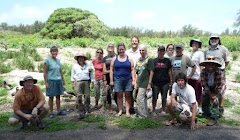
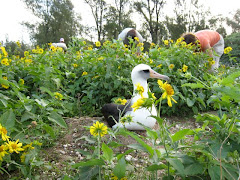
Photo's from the field


Group Write and Poetry

In the evening of our first day we were guided skillfully through journal writing by Sarah and Doug. This was the result of the day’s experience …

“Moli kite
Ka’upu sit
Iwa soar with the sun.
Hollow bones
That uplift life
Hollow bones that make permanent Po beneath skin.” Nai’a


“Plastic Bottle Caps
Small & bright colours
They look like they bring life
They bring only death.

Sand Island
Fields of dark grey down
A mother feeds her baby
Soon Moli will fly

Surprise
Waves break on the sand,
We approach the rusting steel
Back up, it’s a seal.” Al

“albatross
sitting stone still
on the white sand near the
high waters mark
ghostly
wind blows through grey down
clouds grey
sun hidden
nearing dusk
alone
it does not move
eyes not seeing” Norbert

“Manu O Ku
Balancing in mid-air
Never far from your friend
Your fragile toughness and friendly hover
Welcomed friend to the sea farer
Lead us Home.

Young albatross
Today’s my day
I’m gonna try
Those overhead entrance me
How do they do it?
Spread my wings face the wind
Stretch, hop, hop, hop, what now?
I need to watch some more
At least there are many of us.” Chris

“I hope I always remember the adventure of today. Adults handed bikes and freedom, wind, blue skies, fuzzy moli chicks watching our careering progress with somber patience. I loved handing over my usual bag of leadership as I pedaled behind PA’A backs, straight and strong. A rag tag procession through the moli maze.

bike
sand
scrub
bike
hat
backpack
somber fuzzy moli chick
bike
tarmac
carcass
bike
sunburn
smiles
somber buzzy moli check
bike
eyewater
breathless
bike
silence
family
somber fuzzy moli chick” Randi Kika Brennon

Discovering Po


Day 1

Discovering Po.

As sun broke we were able to have our first opportunity to see what lay before us in the land of Po. We were “handed our bikes and freedom” and so began our journey with Pihemanu and the opportunity to explore all that was presented before us. We all set off from the same place, but dispersed in different directions, paths crossing along the way.

Myself, Sarah & Jen cycled to the affectionately named “Bulky Dump” and left our bikes to weave around the nesting fledglings who reminded us of their stand on the island with powerful “claps” of their beaks. Here, on Midway nature has the right of way!

At the end of the spit there were beautiful vistas onto light turquoise water that progressively darkened as the reefs shelved away into the lagoon. You could see Hawaiian Monk seals in the distance and Red Tailed Tropic birds flying above with the soaring albatross. The image is one as you might of a small Atoll in the middle of the Pacific Ocean – simply and overwhelmingly beautiful.

At the end of the spit there was a dead chick – I peeled back the feathers with a stick and the rib cage to find a carcass full of plastic – some large fishing floats and bottle lids. Nature’s genius creations of feathers and bones to protect was no protection for manmade materials. The impact of discovering this is so much more than seeing the photos – although hard to believe. Where did that bottle lid come from? Did the user ever realize it’s fate to our seas and oceans?

Do we ever stop in our daily lives and consider the journey of our latest toys, paintbrush, lighters or food packaging? The materials used to make it - the fuel needed for transportation and its eventual fate.

If one day we were all to consider the journey from the beginning of all the components of our purchases to their eventual fates and all the consequences in between – would we behave differently? We are in an era of convenience but convenience does not equate to better for us now or in the future. Life in all its forms takes time, care, and consideration to create fulfillment, health & happiness for the present and for our future and the legacy we leave behind us.

Sometimes we need to face the harsh realities of what we do to nature. The act of peeling away the feathers and breaking the rib cage and lifting the sternum – is like peeling away your consciousness. The contrast between this and the beauty of Midway does nothing but inspire and motivate change.

Consider this – in Johnstone Museum on the mainland we saw the beautiful cloak aha’ula – feathered cape of King Kamehamaha’s wife – originally. Sadly, after visiting England the King and his wife both died from measles and so the cloak was passed to his daughter. This large cloak showed the finest workmanship and was made from beautiful small golden yellow feathers from the “mamo” bird which covered the cloak. The bird catchers or “kia manu” would collect the feathers which there were only a few of on the wing and tail of each bird. The way this was done was to cover the branch with sticky sap and then once the bird landed they would carefully remove the molting feathers – clean the birds’ feet and return them to the cleaned tree. The work involved in this process alone showed how much time and care went into the making of that cloak. How happy the King’s daughter must have felt to wear such a beautiful cloak and proud the people who helped in its creation.

Do we feel the same way when we buy something that has had a questionable past and an uncertain future?

That is the magic of Pihemanu – the opportunity to let nature teach you, to consider our lives and journeys that will be influenced by Pihemanu but ultimately to think! While doing this we are so amazingly fortunate to be surrounded by the beautiful majestic creatures all around us – Albatross, Hawaiian Monk Seal, Fairy Tern and of course – all the people.

Introduction: Hugh Story

Hello,
My name is Hugh Story. I'm a part-time Global Studies teacher with the Pacific and Asian Affairs Council (www.paachawaii.org) at Aiea High School on Oahu.I work full-time as a sales analyst at the Hawaii Coffee Company (www.hicoffeeco.com).I'm a former Peace Corps volunteer in Kazakhstan ('99-'01) and worked as a small and medium enterprise development contractor in Kazakhstan and Bulgaria.I recently completed my MBA from the University of Hawaii. I'm a member of the Returned Peace Corps Volunteers of Hawaii and volunteer annually with the Great Aloha Run and Habitat for Humanity.Having grown up in Virginia Beach, I always had a connection with the ocean. Actually, my two years in the Peace Corps ended up giving me the most appreciation for the sea. Kazakhstan is the largest landlocked country in the world. In the center of the country is a point of which you are the farthest from any ocean. My assignment was in the middle of this country. I loved my experience but pretty much vowed to never be that far from water again.I'll be working on studying elements of Midway that can serve as a blueprint for a basic educational Flash-based video game. On occasion I've used higher end 'serious games' to help educate students and engage them. The best example is the Food Force game developed for the United Nations World Food Programme. It's a free download which engages students in 6 missions which covers the core duties and obstacles faced by food aid workers. Students put themselves in the role of an aid worker. It's very engaging and students ask throughout the semester to play the game again and again. I'll be giving a short-presentation about educational gaming before the trip.Our lessons have a sustainability component and we teach kids about limits with linear systems inherent in a global Materials Economy. I'm trying to find new ways to educate on closed-loop systems and have young people care about the environment around them. If resources allow, I would be interested in creating a small documentary of the trip. I'm involved with 'Olelo community television by producing, filming and editing various programs. I'm looking forward to meeting everyone and having an unforgettable experience.Aloha,Hugh

Introduction: Chris Baird

ALOHA EVERYONE,
MY NAME IS CHRIS BAIRD AND I AM LOOKING FORWARD TO MEETING ALL OF YOU. I AM BOTH VERY IMPRESSED AND A BIT INTIMIDATED WITH SOME OF YOUR BACKGROUNDS AND EXPERIENCES.
I AM A TEACHER AT OLOMANA SCHOOLS,WHERE FOR THE LAST 23 YEARSI HAVE BEEN ASSIGNED TO TEACH AT THE FAMILY COURTS JUVENILE DETENTION FACILITY.I AM A SOCIAL STUDIES TEACHER, BUT WE END UP TEACHING ALOT OF EVERYTHING TO A WIDE RANGE OF LEVELS,AGES,GRADES AND ABILITIES.I TRY TO BRING AS MUCH LIFE SCIENCE AND OCEAN STUDIES INTO THE CLASSROOM AS I CAN. WE'VE CONSTRUCTED AQUARIUMS AND TERRARIUMS,GROWN VEGETABLE GARDENS,MAINTAINED TARO LOI'S,RAISED FISH AND FROGS AND JACKSON CHAMELEONS.
I ENJOY PADDLING,SAILING,GARDENING,PLAYING WITH MY DOGS AND SPENDING TIME WITH MY WIFE MICHELLE AND MY SON NANEA.I AM A LONG TIME PADDLER AND BOARD MEMBER OF HUI NALU CANOE CLUB. I AM ALSO A MEMBER OF THE POLYNESIAN VOYAGING SOCIETY AND CREW MEMBER ON THE VOYAGING CANOE "HOKULE'A".
I SPENT MOST OF MY YOUTH GROWING UP ON KAUAI. I HAD A FANTASTIC CHILDHOOD LIVING IN WAIMEA. AS KIDS, WE COULD SURF AND DIVE IN THE OCEAN, SWIM AND FARM IN THE VALLEY AND HIKE AND CAMP UP IN THE MOUNTAINS OF KOKE'E. ALL THESE ACTIVITIES KEPT US OUTSIDE ENJOYING NATURE AT HER BEST..I STILL ENJOY GOING UP TO KOKE'E AND PICKING MAILE AND MOKIHANA.
AS KIDS ,WE PRACTICED CONSERVATION AND RESOURCE MANAGEMENT WITHOUT EVEN KNOWING IT. WE WERE TAUGHT TO TAKE ONLY WHAT WE NEEDED AND TO SHARE ANY EXTRAS WHETHER IT WAS FISH OR TARO OR MANGOS.
AFTER HIGH SCHOOL, I ATTENDED WESTERN WASHINGTON UNIV. WHERE I MAJORED IN PARKS AND RECREATION. ONCE AGAIN, I FOUND MYSELF INVOLVED IN ENVIRONMENTAL ACTIVITIES AND PROJECTS.
I LATER RETURNED TO SCHOOL AT THE UNIV. OF HAWAII WHERE I GOT MY TEACHING DEGREE WITH THE INTENT ON RETURNING TO TEACH AT WAIMEA HIGH SCHOOL.WELL..........THAT WAS 25 YEARS AGO AND I AM STILL HERE IN HONOLULU.IT'S ALL GOOD!!!!!
MY MAIN ENVIRONMENTAL INTEREST THESE DAYS FOCUSES ON THE REMOVAL OF INVAISIVE ALGAE FROM MAUNALUA BAY IN EAST OAHU. A NUMBER OF YEARS AGO UNDER THE GUIDANCE OF DR.ISABELLA ABBOTT,CELIA SMITH AND DR.KIM PEYTON, MY WIFE SPEARHEADED THE REMOVAL OF INVASIVE ALIEN ALGAE PROJECT. WE WORK WITH AND TRAIN HER STUDENTS WHO THEN TRAIN COMMUNITY VOLUNTEERS IN THE REMOVAL OF ALIEN ALGAE. MY WIFE HAS ADDED THIS PROJECT INTO HER CURRICULM AT KAISER HIGH SCHOOL.IN THE LAST COUPLE OF YEARS OTHER COMMUNITY ORGANIZATIONS HAVE BECOME INVOLVED IN THIS NEVER ENDING PROJECT.
WE HAVE ALSO TAKEN MY WIFE'S STUDENTS TO THE ISLAND OF KAHO'OLAWE WHERE WE TOOK PART IN OPIHI MONITERING AND FISH (PAPIO)TAGGING.WE HAVE ALSO GONE TO THE BIG ISLAND TO PLANT KOA SEEDLINGS AND HELPED TO CLEAR INVASIVE MANGROVE FROM HE'EIA FISHPOND.
I AM LOOKING FORWARD TO SEEING BOTH THE ISLAND AND SEALIFE ON MIDWAY. A LITTLE OVER A YEAR AGO I WAS FORTUNATE TO SAIL ON THE HOKULE'A TO PALMYRA ATOLL. IT WAS A WONDERFUL EXPERIENCE AND I LOOK FORWARD TO COMPARING PALMYRA WITH MIDWAY.I AM ALSO LOOKING FORWARD TO SEEING THE REMNANTS OF WWII ACTIVITY.I HAVE WATCHED ALOT OF THE HISTORY CHANNELS SHOWS ON MIDWAY.
TAKE CARE AND I'LL SEE YOU SOON,
CHRIS BAIRD

Introduction: Marion Ano

Aloha e nā hoa,

‘O au nō, Marion Ano. Welina mai iā kākou! I hope this message reaches all of you in good spirits. I can’t believe we are a week away from our trip to Midway Atoll. I look forward to meeting each of you in person this coming weekend. I know this lifetime opportunity to travel to Midway with all of you will deepen my knowledge and aloha for the ocean. Furthermore, this experience will strengthen my ability to advocate for the protection and rightful use of this amazing life-sustaining resource.
For me the ocean has been a great teacher and I’m continually humbled by its vastness, power, and greatness. It saddens me that our oceans have been incredibly depleted of its resources and polluted by humans. I look forward to discussing these issues with each of you and hopefully we can develop solutions to solve some of the challenges and problems we face.
In my current work, I am an intern at NOAA’s Pacific Services Center. As a geospatial processor, I’m working towards creating data visualizations or interactive visuals that utilize NOAA’s scientific data to help students, teachers, and the others understand the different processes, impacts, and dynamics that are occurring on a global, national, and local levels.
Mahalo for this opportunity! See you all soon!

Ke aloha no,Marion

Thursday, June 10, 2010

Introduction: Sarah Wilson

I grew up in a small coastal town in San Diego County, California (Vista, California). My family had a sailboat when I was growing up so I spent summers exploring around Catalina Island. I loved fishing as a child and snorkeling the most and would spend hours in the water. These ocean experiences sparked my passion for the sea and its creatures and I knew since I was 6 years old that I wanted to be a marine biologist. So that is what I do with most of my time... I am on, in, and around the ocean as much as possible and happiest when I am sharing the wonders of the sea with others! I studied marine science at UC Santa Cruz and received a BA in Biology and then a MA in Science Education from San Diego State University. I currently am the Ocean Education Manager at the National Geographic Society working on the new Ocean Now Initiative and recently traveled the world by private yacht teaching all school topics, scuba diving, and marine biology for 5th, 7th, and 9th grade students. I have worked in education management, animal care and training, exhibit creation, instruction, and program development at top institutions including Sea World, San Diego Zoo, Birch Aquarium at Scripps, Dolphin Research Center, and the Ocean Institute. In addition, Sarah I work as a science and education specialist publishing books, websites, and teaching guides for National Geographic, Scholastic, IMAX Films, Scripps Institution of Oceanography, and the multi-agency marine portal website Thank You Ocean (www.thankyouocean.org). I also have extensive marine field research experience ranging from being a NAUI Scientific Master Diver in kelp forests and coral reefs to a sea turtle and marine mammal observer. I have spent over 15 years working as a Naturalist on various ships all over the world introducing the wonders of whales in Alaska, Baja Mexico, and Hawaii to teaching snorkeling and diving around the globe.
I have dreamed of visiting this beautiful remote chain of islands for years and that desire has grown even more since its creation into one of our Marine National Monuments. A place that “seems” so far removed from human impact is filled with evidence of our capacity to harm the ocean and its wildlife. Papahanaumokuakea is an ultimate learning laboratory for the marine environment due to the presence of species that are both robust and fragile in their nature. I am looking forward to learning and experiencing a wild and special place that is a baseline for conservation as well as an area in need of preservation due to the quantity of endangered and diverse species. The islands are so unique and inspire action for protection and awe from its beauty. My project plan is to teach and inspire others about the ocean through the creation of a series of workshops to be held across the country to ocean stakeholders, such as boat captains, lifeguards, and those in the scuba diving industry. These workshops will supply ocean information and outreach materials to those on the front line of public interaction about our ocean and will enable these stakeholders to inform their visitors on ocean issues and conservation. We have the power to damage or protect our own backyard, local seashore or waterway, or a place that seems a world away like Midway Atoll.

Introduction: Doug Schmid

First I would like to express gratitude to the U. S. Fish and Wildlife Service, the National Oceanic and Atmospheric Administration, the State of Hawaii and the entire PAA team who have worked to provide this year’s team with this opportunity to experience Midway Atoll.

I also am looking forward to this program, at this place so isolated from human settlement, to see such an extraordinary and abundant part of our world. I have read about the huge colonies of nesting albatross and other seabirds and the remarkable life in the atoll’s reefs. I come from a heavily developed place, outside New York City, where the works of people are everywhere.

Here on Long Island we have a dense population and considerable pressure on our environment and natural resources. In my lifetime I have seem a great diminishment of the natural world. As a boy my local bays were full of game fish and clams and the spring skies were vividly colored with migrating warblers and noisy waterfowl. More recently I have seen our bays unnaturally full of algae, with eelgrass meadows gone and fishermen failing to find once numerous fish. I’ve led many post-mortem necropsies with high school students on marine animals. We’ve found plastic balloons that have compacted in the stomachs of loggerhead turtles causing death.

There has been much discussion lately about how our children are becoming more divorced from the natural world that sustains us (with every breath we take!). Most people here live a busy, suburban life, divorced from meaningful experiences with the natural world. We find ourselves less connected to and less understanding of nature around us. Our technology and standard of living insulates us. I think this “disconnect” from our life support system is a real problem for our future and must be addressed. Baba Dioum said “For in the end we will conserve only what we love. We will love only what we understand. And we will understand only what we are taught.” If he is right we have a responsibility to be the guides and teachers for the generations to follow. I hope to be better equipped to be one of those guides after working and learning as part of our PAA team.

Lastly, as our lives become ever busier and our time for reflection less, I hope to have the gift of time at this magnificent place- time for perspective and the time to absorb and understand some measure of the natural world at the Papahānaumokuākea Marine National Monument.

Introduction: George Hanks

Aloha from Texas!
My name is George Hanks and I am truly excited to be apart of the PAA program this year! Although I now live in Houston, I am originally from Breaux Bridge, Louisiana, a small town in the heart of Acadiana bayou country (think gumbo, beignets, crawfish, zydeco music and .. . alas ¼ most recently the oil spill!). I am a volunteer marine sciences educator with the Flower Garden Banks National Marine Sanctuary and I have served as a volunteer educator with the Houston Bar Association’s Lawyers In Public Schools Program. As a volunteer educator, I teach children in under-served Houston communities about our diverse marine resources and the importance of their conservation. I am also an avid scuba diver and amateur underwater photographer and I have been fortunate to travel throughout the Pacific Ocean learning about our island communities and diverse marine resources. I have enjoyed bringing these experiences back to my students in the classroom. As a diver, I have served as a Naturalist On Board on live-aboard dive boats visiting the Flower Garden Banks, teaching divers about what makes our national marine sanctuaries such special and important places for all of us.
After practicing law for 12 years, I served as a district court judge in Houston for two years and for the past eight years I have been serving as a justice on the Texas Court of Appeals, 1st District.
Jacques Cousteau summed up the challenge of marine conservation when he said “People protect what they love” and preserve what they understand. The key to promoting conservation and stewardship of our oceans is showing people how truly interrelated we are on this planet and how the actions of one person affecting our oceans can impact hundreds of lives thousands of miles away in more ways than we can imagine. We need look no further than the recent oil spill disaster in the Gulf of Mexico to see that no matter who we are, where we live, or what our circumstances, our lives and the lives of future generations are inextricably intertwined with the fate of our oceans.
Participation in the PAA program offers a once-in-a-lifetime opportunity to experience the special bond that we all share through the ocean. Among other things, through this program I will not only see first-hand how current international polices have affected our Pacific Ocean resources but I will also be a part of current efforts to preserve these resources for future generations. As part of this experience I will learn about the impact of these policies on the Hawaiian people. I will use this experience and the relationships with my colleagues developed through this program as a catalyst to establish an ongoing “Sister Schools in Conservation” program for middle and high school students. Through this program, students will see that there are names, faces and even entire communities dependent on our conservation efforts and they will develop a greater appreciation of the importance and urgency of conservation efforts world-wide. I want the program to empower these students to take active roles in the stewardship of our oceans and inspire other students to do the same.

Introduction: Jennifer Barrett

Jennifer Barrett is an Extension Agent with the University of Hawaii Sea Grant College Program, where she coordinates a marine education program related to ecosystem restoration and management in Waikiki. Thanks to her mom, she spent much of her youth exploring the outdoors as a Girl Scout. She attributes her pursuit of "work" adventures at sites including Bishop Museum, San Francisco Zoo, Hanauma Bay and Coconut Island, to those early
encounters. It's what also inspired Jen to propose the development of a Junior Girl Scout badge as her stewardship project, the focus of which will be marine protected areas. Jen is also pursuing a Master of Environmental Management through Duke University's Environmental Leadership Program.

Introduction: Randi Brennon

My name is Randi Brennon and I live on the island of Hawai'i. I am fortunate to teach 7th and 8th graders all day, getting them out of the classroom as much as possible and taking care of several sites in our community. We explore our island and our education through Project-Based Learning methods. It's exhausting and invigorating at the same time.
I am deeply excited about the opportunity to go to Kuaihelani (Midway Island). I'm looking forward to meeting the honu who live there, and the monk seals, and all those birds! My oldest son is named Koa'ekea, a bird found on this eastern-most side of the island chain, and it's exciting to know I'll be going to the nesting place of the Koa'eula on the western end of the island chain. I'm hoping to take lots and lots of pictures while we're there. One of the most exciting possibilities for me is the chance to meet and partner with people on projects. Collaboration is challenging and so rewarding. At school, we get our students involved in all kinds of things, and I can't wait to see what comes out of our adventures together through PA'A. So here's to our upcoming work and play together...see you soon!Randi

Introduction: Robin Craig

My life has been a multi-start attempt to blend my love of the oceans, my interest in science, and my humanities bent into a single career, and environmental law proved to be the right vocation. I grew up in southern California, in Long Beach, within biking distance of the ocean, and some of my happiest memories of childhood are of spending long afternoons boogey-boarding at the beach. In college I majored in English, but took the equivalent of a minor in biology and chemistry -- I loved learning the science, but I quickly discovered that my tolerance for lab work maxed out at 8 hours per week. The first attempt at blending the two loves was a Masters program in Writing About Science at The Johns Hopkins University, but full-time employment as a science writer is hard to come by. However, I got to be a Teaching Associate at Hopkins, which convinced me that I wanted to teach in some capacity.
After Hopkins, I pursued the teaching goal by spending two years teaching marine biology and island ecology at the Catalina Island Marine Institute on Catalina Island, California. That's also where I become SCUBA certified -- the Institute was a licensed dive facility, and we spent most of our free time out in the Zodiacs diving. I enjoyed living with the rhythms and fluctuations of the ocean, and one of the years I was there was a strong El Nino year. Just when I thought I'd gotten the native fauna down, the currents brought all sorts of strange creatures up from Mexico and even South America. : ) I also met my husband of almost 22 years on Catalina -- he was a new teacher that I was in charge of training.
After that, more grad school, because I'd figured out that I wanted to teach at the college level. My husband actually talked me into law school, because I had absolutely no inclination to be a litigator. However, environmental law suits me perfectly, and while I was in law school I got to work in the General Counsel's Office, Natural Resources Division, of the Oregon Department of Justice. There, I got to work with the lawyers who advise Oregon's environmental agencies on new programs and regulations -- proactive work, with no litigation involved. I was hooked! While there, I got to work on salmon issues, tribal issues, and all sorts of water issues, ranging the gamut from standard water quality regulation under the Clean Water Act to helping to assemble Oregon's coastal zone management plan.
After graduation, I worked for a federal judge in Oregon, who was delighted to send all his environmental cases to my desk. Toward the end of my tenure with him, the Lewis & Clark School of Law asked my to teach a night course, and my legal teaching career was launched. That's what I've been doing ever since, and it has allowed me to focus, as one of my areas of specialty, on ocean and coastal law. In particular, I've developed an interest and expertise in marine protected areas, coral reefs, ocean sustainability, and, most recently, climate change.
Its hard to work in this area of law and remain hopeful for the future of the oceans. There are so many debilitating stresses on marine ecosystems, and the law is often completely inadequate in protecting these resources. Marine protected areas aren't the full answer, but they do provide, I think, one of the best hopes for transitioning marine ecosystems through the climate change era. I've been fascinated by the efforts to protect the Northwestern Hawaiian Islands from the beginning of the legal efforts to do so and have actively compared those efforts to coral reef protections in Florida, such as the Florida Keys National Marine Sanctuary, and elsewhere in the world, such as the Great Barrier Reef Nation Marine Park in Australia. This opportunity to visit the Papahanaumakuakea Marine National Monument is, quite simply, a dream come true for me, both professionally and personally. I think large ecosystem-based protected areas like this one represent one of our best hopes in making progress toward sustainable use of the seas, even with the mounting stresses of climate change and pollution, and I look forward to observing the operations of the PMNM up close. (Okay, and on a less grandiose note, I'm also hoping to observe many of the native species while we're there. Seeing a Hawaiian monk seal in person would be spectacular!)
Robin

Introductions: Norbert Larsen

Aloha.

My name is Norbert Larsen. I am originally from Hilo on the Big Island of Hawai`i. I've made home on O`ahu for the past 22 years. I feel humbled to be a part of PAA this summer, and I’m looking forward to meeting everyone!

I am currently a fourth grade teacher at Wai`alae Public Charter School on O`ahu. I was an Education Specialist in Hawaiian Natural History for Moanalua Gardens Foundation for ten years, where great environmentalists and activists of Hawai`i mentored me. I hosted television series on public television exploring the Islands, Polynesian voyaging, as well as natural resources of America. I was fortunate to work at Bishop Museum on the `Ohi`a Project, with a team of people to whom I owe deep gratitude for teaching me a way to educate kids and classroom teachers about native Hawaiian ecosystems. In addition to being an environmental educator, I performed with a wide array of modern dance and ballet companies in Hawai`i during the 1990s.
I hope the PAA 2010 program helps me to achieve active stewardship of natural and cultural resources within my home community. I want to be a better, stronger leader. Great people inspire me, and wild places inspire me. I know the PAA experience will put me in touch with both great people and a very special place. In turn, I intend to evolve Wai`alae Public Charter School into a leading institution for environmental and cultural stewardship in our area.
See you in a few weeks!
Norbert

Introductions: Maya Plass

Already Midway Atoll and the Papahanaumokuakea Marine National monument has had a big influence on me. At the end of last year I had an email from Ron Hirschi (a participant on the PAA trip in 2009) asking if I would like to have Fred the Monkey come visit me here in the UK. Naturally, I said yes and so began an amazing journey that I am still finding hard to believe. Fred the teddy monkey came to me in a little brown box full of materials and information about this tiny island called Midway Atoll. The stories, situation, and wildlife that I learned about were incredible. He was spreading the word on marine litter, ocean conservation and about Papahanaumokuakea.

Here, in England I work in South Devon from “Learn To Sea” working with children and adults on marine conservation issues. We run beach cleans, marine conservation workshops, after school classes etc. and within this I am often found to be talking rubbish! A global perspective of the Pacific Garbage Patch and its impact was & has been really interesting for me. Fred has become a great work assistant and we have travelled to schools, local tourist attractions and talked about the impact of marine litter on Midway and locally. So it was through Fred & Ron that this opportunity arose and one I couldn’t pass up!

I feel so very honoured to be the first international participant and will take away and give as much as I possibly can. Work is already underway with a local primary school to prepare them to twin them with another school in Hawaii. I hope that they can share culture, friendship, traditions and stories and share and compare their coastline and common threats in a wonderful celebration of the ocean with a global perspective. Hopefully, this will be a pilot study that will then be rolled out to other schools in the area and create lots of sister schools! So that is a prime aspiration for this trip to find a sister school for Blackawton Primary School and develop a program of twinning.

There are so many things that I hope to achieve from this trip – new friends, experiences and knowledge. It is an amazing opportunity to share 10 days with other marine educators to brainstorm on all things ocean and coastal. All the time we will be being inspired by all the amazing wildlife and people around us. I look forward to learning about different marine education styles, tips, knowledge & experiences and gaining new perspectives.
I know this trip and magical place has already touched me deeply. I eagerly anticipate where it will take me, Learn To Sea and the children of the schools in South Devon in the future. It is a great privilege and opportunity which we will share to promote the protection and conservation of our seas both near and far.

Introductions: Al Braun

Aloha kakou, My name is Al Braun, and I am a flight nurse and paramedic with Hawaii Life Flight (formerly Hawaii Air Ambulance). My wife, Tara, our daughter, Anna, and I live in Hilo, and I work in Kona. I am a former firefighter and US Navy veteran. I was born and raised here, but I have traveled extensively, and I returned home to the land of my kupuna to use my talents and abilities to care for Hawaii and its people. As a surfer and a hunter, I have been involved in conservation my entire life, but the birth of our daughter in 2007 made the importance of preserving our aina suddenly much more crucial. I am not an educator by trade, but education is part of my occupation and part of my personality. I am humbled to have been selected, and to be part of such an incredible group. I hope to incorporate the knowledge from the Papahanaumokuakea Ahahui Alakai in the development of a land lab experience to educate Hawaii's residents on the connections between our culture and environment. I look forward to meeting and learning with all of you.Malama pono,Al Braun, RN BSN EMT-P