REFLECTION 2
by Marion Ano
My Return: A First Reflection
I have to admit returning home gave me a strange feeling. We touched down on O‘ahu at about 3:45am in the morning and in the pre-dawn hours I yearned to be back on Pihemanu. After saying our goodbyes to each other in the parking lot, I thought most about how I would share my experience with others. It didn’t take long for reality to set in that I was home and in the dark I already saw it in a whole new way. As soon as I arrived to my house I turned on my computer and looked at my pictures. I could not stay away.
A week ago today, marks my first day on Pihemanu and I miss her smell, the birds, their young voices, the incredible presence of life, the mana (life force), and the ancient spirit of that place. To be honest, I have not fully digested the experience. The space and time to do so is not as readily available here, but I’m glad to have the opportunity to reflect upon it now.
The one thing that strikes me the most upon my return is how much we have destroyed our home and how amplified our presence is here. When I compare the dormant town of Midway to Honolulu, I notice the noise. I’m just so grateful for the quiet moments I had on Pihemanu where for the first time I heard the heartbeat of Mother Nature. I’m trying to be as cognizant as I can to stay with this feeling and remain a catalyst for my own change and to inspire others to do so as well.
The lack of wildlife here is piercing and the baseline has shifted so far. I think about that a lot more than I used to. I view Papahānaumokuākea as part of us, the pae ‘āina (archipelago), and I yearn for those mea ola (living things) that connected the entire chain. If we begin to seriously consider what’s missing here and why, we would work together to repair our connection to the pae ‘āina (archipelago) as nature had worked so hard to do way before our time. Maybe, these young islands can once again be as enchanting and powerful as they were millions of years ago. Could we live in a world where more would be respected and left alone? I hope to keep this conviction close to my heart as time begins to divide my attention. I’m trying hard to remain hopeful, for our children, grandchildren, and the honua that I love so dearly.
I’m anxiously awaiting my weekend trip to Ka‘ena point to see some of the seabirds and other wildlife. I wonder what they look like here and hope to share what I know about them with my ku‘u mau hoa makamaka (my dear friends) that join me.
I had a conversation with a good friend yesterday who has also had the privilege to journey to Papahānaumokuākea and we agreed that parts of the experience could not be captured in words or in a photograph. The only way I know how to hold on to the spirit of this journey is to humbly channel aloha ‘aina (love of the land) and remain steadfast to do all that I can to protect this pae ‘aina. There is no price, there is no cost, there is only love.
Special mahalo to the pae ‘āina, the PAA ‘ohana and facilitators, my family (especially Mom and Dad), my ku‘u mau hoa makamaka (my dear friends), my mentors, and my colleagues.
Me ke aloha no,
Marion Ano
Wednesday, July 7, 2010

Reflections from the PAA Group
Participants from the PAA group have been asked to sit, back, relax, and reflect on their journey at Midway Atoll. The first reflection to come in is by Al Braun.
REFLECTION 1
by Al Braun
Flying a cardiac patient to Queen's Medical Center, I look out the window westward at the painted sky at sunset. My mind drifts back to our time on Midway Atoll. It's been a week since we returned, but it seems much longer.
Everywhere I looked over the last seven days there have been reminders of that special place: spinner dolphins in the water off Honokohau harbor, pictures of ulua in the doctor's office, coral on a show on the Discovery channel, and honu grazing on seaweed near the shore in Keaukaha. Each image evokes feelings and emotions that overwhelm me.
Not all of the feelings are positive. I see a myna bird carrying a piece of rubbish and think of moli chicks with their stomachs full of plastic debris accidentally fed to them by their parents. I walk through a store and see a plethora of plastic products. I wonder how many of them will eventually find their way to Pihemanu's shores.
My efforts to conserve resources, recycle, and be a more conscientious consumer have been exponentially increased. Sometimes I feel like I'm proselytizing when I tell anyone who will listen about the things I learned during this experience. When I talk about Hawaiian values, it's no longer some ethereal subject, but a practical way of life.
My life has been changed in ways that I never thought possible. I have embraced my past and look toward the future with hope and determination. I know I'll never be the same.
Saturday, June 26, 2010
moli chick


paddle feet
snapping beak
wings outstretched
flight at rest
flight at rest
plaintive call
sitting tall
wacky hair
style and flair
back to the sun
move as one
moli chick
what a trip!
Friday, June 25, 2010
Shoreline Walk

An evening walk in the waters of North Beach inspired this poem. My friends gathered in close conversation at one end of the beach, a monk seal mom and her pup lay at the other end of the beach. Noio families inspected my presence from the air, then landed on the water within arms reach. Albatross continued their silent, relentless landing and take-offs as they cared for fuzzy chicks. Sensed by all, noticed by none, I gave myself over to the silken waters and caressing sand.
gently sinking into waters too blue to describe
feeling the sand envelope my feet and the water embrace my neck
silken waters push, pull, nudge, hold
this blue is not blue...this blue is nowhere else but here
this blue is not blue...it is grey, beige, white, green, charcoal, everything but blue
the blue, blue sky is blue and meets these waters that are too blue to describe
moli soundlessly soar above my outstretched hands,
clear water drops falling from splayed fingers back to the blue
noio bob and swoop over my bobbing head
monk seals hump and ripple on white bright shores
these waters...that are too blue to describe...hold me
Thursday, June 24, 2010
Departing Letter from Pihemanu


Aloha mai e kuu mau hoa makamaka,
Tonight is the last night I will sleep on Pihemanu. In all honesty, I'm not ready to come home. A few of the PAA ohana are still awake in the lobby of Charlie Barracks with me as we cherish our last night together and hang onto this space and time. Earlier tonight, the crew shared some beers and good laughs, the kind that make your stomach hurt so bad that you realize that you haven't laughed that hard in a while. And you suddenly realize you have exactly what you need, no more and no less. In under twenty four hours we will all be in our seats on the the plane (G1) heading for O'ahu.
To me, Pihemanu is a work of art. Everywhere you look it is virtually impossible to deny her beauty. In many places around the atoll, her abundance, wealth, life, and depth is juxtaposed against a history warfare and military occupation while Midway atoll served as a strategic battleground and front in the middle of the Pacific in WWII and the Cold War.
There is not a single person on this trip that allows a way for the wonderment, aloha (love) and fascination for this place escape them. Each individual's experience is the same in this way. In fact, as our time here progresses we arrive with new questions and inquiries like any young child would. So, what this means is on Pihemanu we're granted a second chance, maybe third to start all over again and rediscover a new place through the eyes of a child. Some of our questions can be answered with simple facts and others may require us to ponder. To say the least, it has become easy for me to forget about my life back home which affords me to look inward and re-examine my kuleana as a Native Hawaiian, marine conservationist, educator, lifelong student, and global citizen. But, I remember each day that these moments are precious and I trust that my kuleana that builds upon the southeastern horizon is something that I can fulfill in this life.
The focus of my inner dialogue brings me to share a few things with you about my relationship with the kai (ocean). My earliest memories of the ocean take me back some twenty five or so years ago. I remember my father, holding me with his hands under my belly instructing me through my first series of swimming lessons. I must have been instantly drawn to the water because I have never fallen out of love with the ocean. As a child I also have fond memories of snorkeling at Hanauma Bay and it was there where I first discovered life below the surface. At that time, visitors to the bay could still feed the fish with little pellets they used to sell there. As most of you know, times have change and people can no longer feed the fish. For those of you who live in urban Honolulu, I encourage you to visit this special place. As the ocean's baseline continues to shift for the worst and fish stocks and coral health decline pu'u honua (refuges) like Hanauma and Papahanaumokuakea remind me of the power of protecting a place in perpetuity for its biological, cultural, and social significance and its power to heal not only nature but mankind itself.
When I am in the ocean whether it's surfing, paddling, fishing, snorkeling, swimming, or diving I feel that my great grandfather is with me. He was a man of the ocean and my father and uncles speak admirably about their grandfather who knew so much about the place that he loved. It is only later in life that I began realize that it's not a mere coincidence that I find myself in the same line of work my grandfather was doing as a fish and game warden some 50 to 60 years ago. As my dear hoa (friend) and fellow PAA member, Nai'a, shared, "[we] don't get kuleana from no where".
And so, my journey to Pihemanu is related to my genealogy which for me includes all my ohana (family), ku'u mau hoa( dear friends), my new PAA ohana, and countless others who put tremendous time and energy into mentoring me. My only hope is that I'm able to represent you well here and bring you as close as I can get you to Pihemanu. And so in my last letter to you before I depart from this remote atoll that lies in the great expanse of the Pacific Ocean, I will try my best to take you on one of my journeys into her waters.
There are two places on the atoll where we may explore the underwater world here. All other beaches are reserved for species that are endangered. The light blue waters off of North Beach are the most inviting waters I've ever seen. Conversely, the cargo pier, towards the eastern side of the atoll is an artificial marine habitat created several years ago through the creation of a channel to bring big ships to the atoll. Just a few feet from the sandy shores of the cargo pier, it drops off 50 to 60 feet and gives the feel of a blue water dive. The underwater experience at the cargo pier is a rare one. It feels like a kaleidoscope, so many things happening all at once, and when the much welcomed rays of sunlight illuminate the eerie and murky waters under the pier one feels a little more inviting. The fish are abundant, some are familiar to me, many are not, and some are really big. And so in this manmade habitat there is a mixture of nearshore and deeper water fish species that coexist. In all my time spent diving reefs around the main Hawaiian Islands, never have I seen fish in such abundance in a small concentrated area.
If I count all the hours and pictures I've spent snorkeling under the pier it probably adds up to something like two hours and 800 pictures. All that Pihemanu has revealed to me is not an accident, its a combination of our pule (prayers), the power of intent and manifestation. And so I will leave you with this short story about a special fish to me.
Last week Monday, during PAA's visit behind the scenes of Bishop Museum's incredible fish specimen collection, before exiting the room I kindly asked our guide if they had a preserved specimen of the hapu'u fish. Since it's been virtually fished out of the main Hawaiian Islands and the primary reason why it is such a rare sight, I thought here's my chance to see what it looks like in "real" life. Yesterday, not even ten minutes into our daily snorkel under the pier, I came across the hapu'u not knowing it at the time, got close to it and snapped a photo. After downloading my photos and looking through them (as we obsessively do here on Pihemanu), I found that shot and a sudden feeling of "chicken skin" came over me as I realized what I had seen today. This is life on Pihemanu. Every experience and moment on is a gift, is precious, and is teaching each of us something.
I wish I could share all my stories with you and I look forward to sharing more with you in person. I will see you all soon.
"He wa'a, he moku, he moku, he wa'a"
me ke aloha no,
Marion
To be in that blue
So, in looking through my nifty little notebook that Linda got for us, I came across a scribbled thought I had luckily jotted down. It's a thought that came to me as I reflected on our trek to Eastern Island. As we were walking across the middle of the island, I saw that magical blue of the lagoon reflected off the flat bottoms of the clean, white clouds overhead. At first I thought it was my sunglasses, or my eyes tired from the sun, but Nai'a assured me that I was seeing a traditional indicator to sailors that land was near. Something shifted in me as I looked up at that distinctive, invigorating, soothing blue.
A day later, I remembered that blue when I heard Norbert express his yearning to "be in that blue" as he looked out at the ocean at North Beach. To be in that blue...
Maybe a mission for us? To be in that blue. This is what I wrote in my notebook: just how the clouds reflect the blue of the atoll, and serve as indicators that the atoll is there, so we PA'A ohana members can reflect that Papahanaumokuakea is here...and irreplaceable...through sending out our own beautiful, distinctive, alluring light unique to our experience. We can stand as beacons, ambassadors for the 'aina and the sea that surrounds us. We can continue to be in that blue, and encourage others to recognize and be in that blue as well...
Headed for the Reef!
We were so fortunate to get out to the reef for a snorkel. I succumbed to the phrases that kept rolling through my head during our adventure ("unreasonable blues" "freefall of trust" "humans haul out" "a smile gifted back to the giver") and wrote a quick poem.
bodies sausaged into neoprene,
zippered spine traces human spine
unreasonable blues
in an ocean meant for everyone but us
my smile given back to me in sunglass lenses
perched over other smiles
ocean spray christens us
as we grip metal poles and perch on skinny benches
freefall of trust into cold clear waters
kupukas of coral rest stoically,
impervious to our praise
breathing calms
limbs stretch
pulses slow
life deepens
humans haul out onto shiny metal ledges
the giant ulua travels past,
unimpeded, unimpressed
my smile is given back to me by the caress of the wind,
the warmth of the sun,
the silence of my friends
Chris's Poem
This opportunity to spend precious time on Midway Island has deeply affected all of us. Chris was unparalleled in seizing every opportunity, exploring every corner, connecting with people and creatures and the land the whole time we were there. He blessed us all with the following poem as a gift right before we jumped on the plane to leave. I know I was doing pretty well with managing my emotions up to that point. Chris's poem touched us all, and his open heart while sharing it touched us even more. Thanks so much, Chris.
We started many months ago on this magical tale,
Oh what joy we all felt with our acceptance in the mail.
We all arrived from near and far but we found the way,
Nervously gathering the first time at Hanauma Bay.
Through meetings, sessions and field trips our comfort levels grew
Remembering names and faces, these strangers we know knew.
Bishop Museum was fantastic as we made the rounds,
Then off to the airport where we stressed about our forty pounds.
Our flight was fun with Subway grinds to help provide a spark,
Then touching down on Midway, we reached here after dark.
From day one our days were filled with awesome things to do,
And when we thought it couldn't last, it got better with day two.
Cruising on our awesome bikes we explored both far and near
And everyday we added names of those who jumped the pier.
Eastern Island was unreal, its heyday of the past
With the help of those today its history will last.
Snorkeling out on the reef, boy, what can I say
Unreal feelings of another world, as the fish came out to play.
Sunrises and sunsets are a million dollar view.
How lucky are all of us? Each day we get to see the two.
Birds on the road, birds in the water, birds in the air
I'm so glad they're friendly, or that would be a scare.
Albatross and Monk Seal talks were given by the crew.
These lectures and the tours helped us learn so much that's new.
Thanks to Tanya, thanks to Nai'a who helped to get us through
The various assignments that we've done and those we've yet to do.
Tracy, thank you very much, you've been the very best!
Once we leave I surely hope you're able to get some rest.
Linda, thank you oh so much for getting all of us here.
It should be a lot easier when we return next year.
Unfortunately, our time is short as we wait for our ride
But luckily we've already checked with Toy for a place to hide.
I'm saddened as our wonder time we now see it ends.
I'm deeply honored to be able to call you all my friends.
Chris Baird
Cultural Component


E hō mai ka ʻike mai luna mai ē,
ʻO nā mea huna noʻeau o nā mele ē
E hō mai, e hō mai, e hō mai ē
Give forth knowledge from above
Every little bit of wisdom contained in song
Give forth, give forth, give forth
Cultural Component for PAA Program
by Al Braun
This oli (chant) by Aunty Edith Kanakaole was a fitting beginning to the cultural component of PAA 2010. It is impossible to separate the cultural roots of Pihemanu (Midway Atoll) from its story. Unlike other modules during PAA, the cultural component was woven throughout the entire experience, giving additional insight and perspective to the study of Pihemanu’s history, as well as, it's expected future.
In preparation for our journey to Pihemanu, we spent three days on Oahu learning, growing, and giving to the ‘aina (land) that would ready us for this life changing experience. We learned of the Hawaiian values that are essential for survival on a wa’a (canoe) or a moku (island). These values I was taught as a child resonated with new meaning in this paradigm. Mālama (caring), laulima (working together), kuleana (responsibility), ‘imi’ike (seeking knowledge), aloha (love), na’au pono (doing right), and loko maika’i (sharing) are all needed for a successful voyage, whether that journey is navigating across the Pacific, or navigating a course toward a sustainable future.
We also spent time in Bishop Museum's Hawaiian Hall, where we learned of the culture of a people who crossed the ocean to the world's most isolated archipelago. In the Bishop Museum's archives rooms, we viewed archeological evidence of Hawaiians found on the Northwest Hawaiian Islands of Nihoa and Mokumanamana (Necker Island). We were also able to see examples of kapa, cloth made from wauke (paper mulberry) bark, the scent of which awakened memories of seeing kupuna (elders) making it when I was a young boy.
From Oahu, we travelled on to Pihemanu. When I stepped off the airplane, I was overwhelmed by a sense of awe that I had arrived where the spirits of ancient Hawaiians travelled after leaving this world. The Northwestern Hawaiian Islands were known as Po, the region of primordial darkness where the spirits return after death. This has been a sacred place for generations, and the mana (spiritual power) of this island resonated through and around us.
Throughout our time on Midway, as we absorbed the mana (power) and beauty of Pihemanu, I received many hō’ailona (signs of nature) that spoke to me to pay attention. It was not surprising that in such a sacred place, the messages of the spirit world can transcend the boundaries of the physical world. Ancient Hawaiians knew this to be true, and with each passing day, I became more attuned to the messages being delivered.
Much too quickly, our time in this special place came to an end. The connections I made with myself, my friends, the ‘aina, the creatures, and my ancestors were life-changing. Before departing, I knew that I needed to make a ho’okupu (offering) of thanks to the island in the tradition of my ancestors. My prayer for Pihemanu is one of healing for her and our world.
Wednesday, June 23, 2010
Monk Seals
Monk Seals
By Doug Schmid
Many of us feel a special connection with our marine mammal cousins and here at Midway we have been privileged to see the endangered Hawaiian Monk Seal (Monachus schauinslandi) daily. Starting on our first day here we have seen monk seals cruising along North Beach, hauled out on beaches, swimming by our kayaks, and under the pier at Eastern Island. One mother and pup have been frequently resting and rolling in the water among the metal debris the Navy left behind at a point called Rusty Bucket.
Wherever we have seen them, their liquid grace and smoothness of movement have stopped us in our tracks. Yesterday, some of us observed a mother and pup hauled out near the cargo pier when another adult attempted to approach. The mother's immediate sharp response, with a loud vocalization and lunge at the newcomer, seemed to us a strong example of a mother protecting her baby, something that touches us all.
This morning Brenda Becker, a NOAA researcher, and Mimi Olry, from the State of Hawaii Department of Natural Resources, shared their knowledge about these unique and charismatic animals with PAA. There are only an estimated 1,100 Hawaiian monk seals left in the world, with most of them living in the Northwestern Hawaiian Islands (Papahanaumokuakea Marine National Monument) and they are in trouble.
Brenda has been studying these animals since 1985, often at remote camps on French Frigate Shoals and other atolls. Between 1958 and 1976 their numbers decreased by 50 to 66%. They were listed under the Endangered Species Act and with that protection here at Papahanaumokuakea their numbers expanded. Unfortunately there has been asignificant decline since about 1998. The population is now declining at 4.5% a year and overall they have lost 70% of their population in the last 50 years. The problem seems to be one of lack of nutrition for the juvenile seals. They are underweight, not as robust and many starve and die before adulthood. Females are giving birth and are able to nurse their offspring, but after they are weaned, many of the young seals are not able to find enough food to survive to be the next generation's adults.
It is now believed that changing ocean currents are causing a decrease in productivity in this area and so there is less food for the monk seals. The adults may be skilled enough, experienced enough, to catch food with reduced prey populations. The juveniles on the other hand, just starting life on their own, without an abundant food supply to support their mistakes and early trials at catching their food, are in trouble. Emmaciated juveniles are increasing dying in the NWHI. French Frigate Shoals is also experiencing Galapagos shark attacks on monk seal pups. Since it may be only a few sharks killing pups, in this limited area, it may be possible to control the situation by carefully removing the individual sharks who have learned to "key in" on the vunerable young pups.
It is the ongoing research by NOAA, which looks to tag every individual seal, that has allowed this picture to emerge. The efforts of people like Brenda, living for months at a time in tents on the atolls of the NWHI, have allowed them to understand the lives of the seals. These are amazing animals, with the ability to hold oxygen in their muscles, to dive deep and see in the dark depths. They can move along the entire archipeligo, crossing the distances between the atolls and islands.
Our guest speakers also shared a video from the "crittercam" that was temporarily afixed to the back of one adult seal. This instrument recorded depth and showed the seal diving and filmed its foraging behavior. It was a real surprize to the researchers to see the seal passing by the shallow reef environment and spending its time deep- over 60 meters. Here it actually "rooted" around in the seabed, through sand and rubble, turning over rocks with its head and catching octopus, groundfish and eels. The large predator fish kept it company, perhaps looking to snatch up a meal from the seal's work.
Mimi handles coordianting monitoring efforts on the main Hawaiian Islands and shared some of the issues they face there. In an encouraging sign, the monk seal population is increasing in the main Hawaiian Islands. Over 20 pups were born last year. Although the good news is that seals are reproducing in ever greater numbers there, they are coming into contact with people, often with deadly results for the animals. Drowning in nets, getting hooked, being entangled in our garbage, lines or fish traps and being disturbed on beaches as they try to rest are problems. A pregnant female was recent shot. When a species is as endangered as the monk seals, every individual becomes even more precious and important to the chance the species has to continue to exist. After 15 million years of living on this earth, swimming these waters before the main islands were created, long before we came, they now are trying to hold on. I think we all were touched by Brenda and Mimi's knowledge, strong commitment and passion.
So the monk seals are coming to the main islands. Brenda called the islands the new "baskets of hope" for the species. We'll have to coexist, to make room for them on our beaches, and make changes to our behavior, like using new hooks. It's been said that in the end people will only save what they care about. Will we care and make room for these ancient animals?
Mimi's DNR group is always on the lookout for seals showing up on the main islands. They encourage anyone spotting a seal to call 220-7802 to share that information.
Monday, June 21, 2010
Beginnings

Beginnings
After an informal gathering of a few participants for dinner at an Ala Moana pub the night before, the PAA group (12 participants, 2 alternates and program directors) gathered at the entrance of Haunama Bay on the morning of Saturday, June 12 to begin the adventure of a lifetime, time on Midway Atoll. Everyone got their chance to introduce themselves and say a little about their interests, plans and projects for the upcoming week on the atoll. Then we were all led through a couple of hours of excellent basic instruction on snorkeling by Alan Hong, even though most were obviously well versed in such activity. Although we were only able to paddle around within the very inner part of the famous bay and could only examine briefly the shallow, very near shore, coralline-algal-encrusted relict reef, everyone got a nice introduction/reintroduction to Hawaii's beautiful, always inviting tropical marine water. Doesn't seem like anyone is going to be intimidated by similar settings at Midway; but, how similar is it? Time will tell. After lunch all were indoctrinated in Hawaiian protocol as we entered the PMNM Hawaii Kai office for an afternoon of brief presentations by both monument management staff as well as participants and alternates. Everyone was still gradually getting to know each other while they were gradually owning up to the reality that they were going to Midway. A great first day - it's a process.
Sunday, June 13th, the group really started to come together. Great PowerPoint presentations and videos on a wide variety of introductory topics were presented by the staff, all of which helped to continually build expectations of finally getting to the northernmost coralgal reef atoll complex on the planet. A great presentation was made on research presently being carried out on Midway and throughout the Northwest Islands of the Hawaiian Archipelago, much of which continues to solidify one of the main aspects of the essence of Hawaii, extreme isolation. By definition, when you're the most isolated, you're unique. It seems pretty obvious that if Charles Darwin had ventured by way of the Hawaiian Islands nearly 200 years ago, these islands would be the Galapagos of the planet.
Sunday afternoon was occupied primarily by an interesting, down and dirty work project. Gathering at the Paiko Wildlife Sanctuary along the shoreline of Maunalua Bay, we proceeded to remove invasive pickle weed and then replant a few natives. An amazing amount was accomplished in a relatively short span of time, but even more importantly the group was bonded even more closely together, especially with realization of similarities in goals and work ethics; a great group of talented individuals demonstrating their ability to do great things collectively. Days can't get much better than that.
Monday, June 14th Departure Day. Well, not until late afternoon. The day began with a wonderful, behind the scenes, visit to the Bishop Museum, one of the country's best. We were privileged to be able to examine collections. I was really stoked to be able to see materials, notes, maps and artifacts from the famous 1923-4 Tanager Expeditions, the first real scientific explorations of the Northwest Hawaiian Islands. Items from Necker and Nihoa were displayed; we were allowed to photograph and even touch many of the artifacts. In addition were able to view some of collection of the thousands of native Hawaiian bowls, canoe models, weapons, tapa, pau, etc, etc, etc. At other locations were shown the extensive collections of thousands and thousands of invertebrates and ichthyologic specimens from Hawaii and the tropical Pacific. And finally we were provided time to wander through the wonderful displays of the museum open daily to the general public. What an inspiring place for which Hawaii must feel great pride.
Eventually the beginning had to end and the real journey had to begin. Participants were transported to the airport to first see if they made weight with their under 40 lbs of stuff. Seems like everyone made it. I as one of the hopeful alternates was sad to see all depart without me, but I felt the joy and excitement of the now well-bonded group of adventures. For me being involved in the introductions and meeting such a beautiful, talented group of people was quite a humbling experience, probably one that was somewhat necessary. I know now, more that ever, that I must get to Midway, one way or another.
Respectively submitted
Chuck Blay
My Impressions
My Impressions (beyond Chuck's astute summary, below)
by Michelle Schwengel-Regala
As an alternate who didn't make it on the voyage this year, I'm writing this from my studio on O'ahu, holding the other participants in my thoughts for a safe and fulfilling journey. By going through the multifaceted orientation last weekend, I've come to understand a great deal more about this archipelago I call home. It didn't take long for me to realize that while we talked about plenty of science about the place, it seems that the cultural insights we discussed will be both grounding and driving forces behind our experiences. The words and concepts MAKA'ALA/to pay attention, 'IMI 'IKE/to search, KULEANA/our privilege and responsibility, MALAMA/to care for, among others will be significant motivating forces behind the way we interpret this place and will strongly influence the way we incorporate this experience into the rest of our lives and carry it forth to share with others. As much as we thought we had our projects figured out, one of the program's administrators warned us that "At the end of the experience, you will know why you're here. You think you know now, but at the end, you will KNOW." Even the weekend's worth of exploration gave me a different and clearer understanding of my mission, and I am looking forward to following the transformations of each member of our entire cohort. By stepping into the space to be open to this work, we are already changed by it, and for the better. I am humbled to be a part of this talented, dedicated, and inspiring group.
One small action that demonstrated the way our group is already working together was in negotiating our weight allocations. One member, Marion, was hoping to bring her guitar on the trip, but its weight plus her gear exceeded the 40# limit. Other members who had pounds to spare "gave" those to the guitar cause, and the guitar made it! I'm imagining sweet MELE HO'O LULUHI/lullabies being played to the albatross chicks...
With deep appreciation,
Michelle Schwengel-Regala
Midway: A place of Healing


Midway: A Place of Healing
By:George Hanks
Today Tracy Ammerman with the US Fish and Wildlife Service led us on a tour of the historical buildings on Sand Island from World War II. Many people think of WWII in the Pacific only as a series of battles and dates that they had to to remember in grade school. Since none of the major battles were fought on the US mainland we rarely, if ever, have daily contact with relics from this war. Things are very different here on Midway. Everywhere you turn you see places, buildings, and relics connected to the two battles of Midway, on December 7, 1941 and six months later on June 4-6, 1942. During our tour we learned the personal stories of the young men who lived, fought and often died here. We saw the mess hall where they ate, the chapel where they prayed, and the beaches where they played before the start of the war. Sitting inside now empty pill boxes overlooking the lagoon where sentries once stood waiting for the coming Japanese invasion and inside 5 inch gun emplacments where the shells from enemy ships once rained down, you are instantly transported back to the tense early months of the war. You can sense the raw emotions of the young seventeen year old sailor, armed with a surplus rifle from World War I, after being told by his superior officer to do what you can, because if the Japanese take Midway, they will take Hawaii; to do what you can because if the Japanese take Hawaii, the coast of California will be defenseless; to do what you can, because the Japanese will not take you prisoner. Young men facing the very real possibility that they would die alone, in unmarked graves, in a far away place never to see their families again. Everywhere you turn you sense the power of place.
I did not expect the feeling of peace that I also experienced during the tour at each site.The sites are still. Despite the ravages of war everywhere you look the island is slowly returning to the way it was long before we arrived. On runways where fighters once turned into the wind and flew into into the sky to defend Midway, there are now thousands of albatross chicks turned into the wind flapping their wings in unison and learning how to fly to far off seas. On beaches where Seabees dug entrenchments, there are now little sand crabs digging out their burrow homes. On the shores were once pickets stood to stop Japanese troops, a mother monk seal and her pup roll around in the surf. In pillboxes where young marines once stood guard, fairy terns and tropic birds have now made their homes. In the skies above the ironwood trees where planes off to battle in formation, fairy terns dart and swoop in pairs and then soar up hundreds of feet into the sky on the incoming wind from the lagoon. Looking at what each site has now become you get the sense that the island is healing itself from the physical trauma it has suffered. It is shaking off the effects of war like unwanted dust and once again returning the island to the home that it once was for all of its true inhabitants. At the end of the tour, I walked past a Japanese war memorial near the Clipper House with offerings from both Japanese and American veterans who attended the 68th anniversary ceremony of the Battle of Midway just a few short weeks ago. During the tour Tracy told us that you cannot heal unless you know your history. After coming to Midway, I now know what she means.
Sunday, June 20, 2010
Kanu nei au, aia ʻiā ʻoe ka ulu


Kanu nei au, aia ʻiā ʻoe ka ulu.
“I plant and the growth is yours.”
[ʻolelo noʻeau]
Plant Module 6/18/10
By Norbert Larsen
One of the things that surprises me about Midway is the vegetation. Here there are vast stretches of ironwood trees, as well as plumeria, bougainvillea, coconut, shower trees, banyan, Norfolk pine, octopus trees, sea grape, banana, ti leaf plants and lots and lots of Verbesina (golden crownbeard) a noxious weed from the sunflower family. Prior to this visit, I had a completely different picture in my mind of what the atoll would look like. I imagined naupaka, pohuehue, native grasses and sedges, and other native ground-hugging vines and shrubs that perhaps I had never seen. I envisioned stretches of sand from one end of the atoll to other. I did not expect to see trees of any kind. I learned that tons and tons of soil were placed on the island since the early 1900s, and that thousands of people have lived here and brought with them their gardens and plants. I suppose if I had properly done my historical research prior to arriving, I would have been better prepared to meet the landscape that one finds today. The human footprint is everywhere here.
On this morning, we met Greg Schubert, Bio-Tech for Invasive Species with the U.S. Fish and Wildlife Service. He was a volunteer up here with the U.S.F.W.S. for four years before he was hired. He is going on his 8th year in his current position as Invasive Species Bio-Tech for the refuge, and his institutional knowledge is vast. He tells us that there are 259 species of plants on Midway, and that 19 of these are native. The rest are non-native, and the U.S.F.W.S. is combating 22 invasive species. One of the worst of the invasive weeds is Verbesina, and you can see it everywhere. The U.S.F.W.S. is working at restoring 300 acres on Midway—130 acres has been successfully restored. The success story is motivational. What seems like a daunting and almost impossible goal (native habitat restoration on Midway) is reachable in the optimistic and capable hands of the many people caring for Midway today.
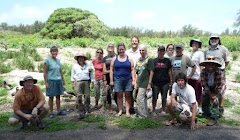
After touring Midway’s native plant greenhouse, the PAA gang participated in our small way by planting native bunchgrass (Eragrostis sp.) on a sandy hillside once covered with Verbesina. On the same hillside, we could see an area planted by the PAA group last year, and the native bunchgrass is becoming firmly established. Greg tells us that the roadway next to the hillside becomes a vector for seeds because the wind blows down the roadway carrying seeds. Instead of carrying Verbesina seeds, the roadway now becomes a vector for carrying the seeds of the native bunchgrass. What an ingenious and efficient way to populate the nearby fields with native bunchgrass! Greg pointed out fields once covered with Verbesina, and now thriving with the native bunchgrass.
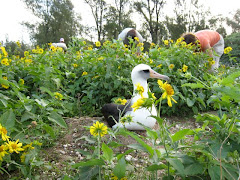
Verbesina was at one time removed with tractors, but this disturbs the soil, distributes seeds and actually encourages the growth of more Verbesina. Today, the U.S.F.W.W. uses a mild herbicide to kill off invasive weeds, or it removes the weeds manually in areas where the herbicide might threaten native plants. Our PAA gang worked near a couple of “duck seeps”—places where the ground has been dug out to reach the water table in order to make habitat for Laysan ducks. We manually removed Verbesina along with several other invasive weeds growing around the “duck seeps” where we could see Laysan ducks and ducklings waddling and paddling around. It was amazing to witness how quickly an area can be cleared when everyone works together!
The camaraderie in our new PAA family is growing, it is heartening, it is making me strong. Activities like this help to bring people together, and I am feeling the “shot in the arm” to make opportunities like this available to students at Waiʻalae Public Charter School where I work. It is clear that our islands are in need of more helping hands, of strong healthy communities, and it is clear that working to heal the environment can be a win-win for the ʻāina and for people.
Mahalo to PAA member Karen Matsumoto with the PAA group that visited Midway Atoll last year for gifting the gloves we used to do our work. The gloves stay here with the U.S.F.W.S. for others to use.
Saturday, June 19, 2010
Letter from Pihemanu


Letter from Pihemanu
By Marion Ano
Aloha mai e na hoa makamaka,
Welina mai ia kakou mai ka aina e kapa ia o Pihemanu. Today marks my fifth day on Pihemanu, a place also known as Midway Atoll. My journey here began on a five hour plane ride from Oahu due northwest over the chain of kupuna islands that span over 1200 miles from the island I call home. By the time our gang, PAA (Papahanaumokuakea Ahahui Alakai) 2010, boarded the plane our bonds were beginning to seal us into an ohana. At any given moment on the plane ride one could hear chatter, laughter, and the occasionally oooooo's and ahhhhhh's as we got glimpses of some of the atolls that lay below us in the distance that most of us would never set foot on.
We arrived on Pihemanu in the dark as all planes must do to protect the lives of birds that are flying during the day and the fledglings that veer to far on to the runway. Five minutes into our arrival, my dear friend and roommate, Maya, who journeyed all the way from England began our opening ceremony by sharing her thoughts, asking permission and for protection during our stay here on Pihemanu. We have continued this tradition and begin each day in a circle, pa'a ka lima (holding hands) and recite the oli, E ho mai, so that we can be open to receive the wisdom of this place and set our pono (righteous) intent for the day.
Although I am here sitting on the most beautiful place on earth as I know it, I still cannot find the words to share with you the greatness of my experience here. As I write this letter and glance over the lagoon, my eyes are greeted with the gift of spinner dolphins breaking the water's surface making their morning run to their next destination. My life here shares a similar tone to theirs. Over the last four days, I have taken close to 2,000 photos of the life and sometimes death that I see and feel around me. I cannot help but wonder if my kupuna (ancestors) set foot upon this aina (land) or if I am the first one in my lineage to. I am tremendously grateful that I have been granted this lifetime opportunity to live here for seven days of my life. It is truly a gift to be here. I knew this when I left, I feel it while I'm here, and I know it needs to be appreciated in this way for rest of my life.
I acknowledge that I am a very lucky person. However, my trip to Pihemanu has elevated this feeling and understanding to greater heights. Each of us who have been selected to come here have been entrusted with a kuleana, now lifelong responsibility to take the lessons we learn here and embody this new ike in all that we say and do.
Pihemanu lies within, Papahanaumokuakea, the world's second largest marine monument. The vision statement of Papahanaumokuakea is "to protect and perpetuate ecosystem health and diversity and Native Hawaiian cultural significance of Papahanaumokuakea. In all my time spent on land or in the water as an ocean user, conservationist, and advocate Pihemanu has revealed things to me that I have never seen in my entire life.
The first time I experienced Pihemanu in the light, I was struck by a feeling as though I were at home. There are things that are familiar here, the ocean, the sand, the naupaka, the warmth of the makani (wind). But, I am in a place that is elder to my one hanau (my sands of birth), that has been altered but possesses a genealogy that is ten times older than the island chain to the southeast. In the dawn's light the omnipresence of the birds alone struck me in such a profound way. And so I will try my best to share its story with you.
The landscape of this tiny atoll as far as one can see in any direction is covered right now with albatross fledglings. Current populations of this manu kai (seabird) are around 1.5 million birds. I know that these birds once dominated our landscape back home. On the first morning, with our new bikes and freedom (as stated by my dear friend, Randi) we explored the atoll dodging fledglings that do not move from their place of birth. These albatross that mate for life only produce one egg per season. Once the egg is laid, the male albatross tends to the egg for thirty days until the fledgling emerges from its inner world. Upon its birth, the albatross parents spends the next four to five months flying out to sea in search of food for their young. For this time of their lives the parents operate only to serve this one intent. In the beginning stages of its life the parent will return every three to five days next three to five days to feed its young. The lucky ones, or the way I see it are those fledglings that are born under a tree rather than in the middle of the asphalted roads on the island. By the time the fourth or fifth month rolls around the parent will extend the search for food for ten days slowly building the fledgling's independence and craving for food. Eventually, the parents will never return to see their fledgling again and the young bird's only way to survive is purely driven by it's own hunger. The fledgling's must break through its threshold to wait for food and dare to take its first flight out into the blue horizon gather the nourishment it needs. If the fledgling survives it will find a mate when that time comes and the cycle of life continues.
There is evidence in many places on the atoll that some of these birds do not survive. Each season, thousands of them perish in the heat, become dehydrated, or suffer from the "droop wing" syndrome from lead poisoning. The most powerful association to fledgling death for me is the ingestion of bits and bits of plastic that are mistaken as food by the parents who mistakingly feed it to their young. Whatever "food" material the albatross is unable to ingest is regerjetated in a bolus. During a bolus examination activity, my group concluded that 80% of the material in the bolus consisted of plastic materials. The message to eliminate the usage of plastic in my life speaks to me on a much more personal and urgent way.
Being here is life changing to say the least. And although that sounds a bit cliche, I know it is because I've been granted experiences like this more than once. Throughout my time here, I have struggled when I think of whether I possess the capacity to really bring you here with me if it's even for a moment so that you can feel the mana (power) of this place the way I do. The journey to Pihemanu is long in every sense of the word, it has taken me thirty years to get here. if I could wish for something for all of you, it would be for you to experience this place. But, for now, I will humbly try the best that I can to be that conduit for you. My seven days here on Pihemanu with my new ohana (family) is truly a gift of aloha and as with all makana (gift) it must be shared with all.
Me ka ha'aha'a,
Subscribe to:
Posts (Atom)