Welcome to the PAA Blog

Papahānaumokuākea 'Ahahui Alaka'i (PAA) is a ten-day experiential leadership program that brings together teachers, business people, policy-makers as well as potential community leaders interested in learning and being inspired by science and traditional knowledge management practices. Papahānaumokuākea Marine National Monument encompasses roughly 140,000 square miles of the Pacific Ocean, an area larger than all the country's national parks combined. The area around the Northwestern Hawaiian Islands is an important safe haven for wildlife such as the threatened green turtle and the endangered Hawaiian monk seal. ‘Ahahui refers to society, club or association. Alaka’i is Hawaiian for ambassador or leader. The Hawaiian word /acronym PAA means steadfast, learned, determined, strong, to hold, keep, retain.

Saturday, June 19, 2010

Coral Snorkel Expedition


The Inner Side of the Outer Reef

Robin Craig
Tallahassee, Florida


On Friday, June 18, 2010, I celebrated my 46th birthday on Midway. While there were many wonderful aspects of that day (a hand-made birthday card and a beach plastic lei from the PA’A group, efforts to restore the island, the Thai kitchen crew singing “Happy Birthday” with a huge carrot birthday cake), the highlight of the day for me was our PA’A snorkel at the outer reef of the atoll.

Snorkeling the inside reef at Midway Atoll requires a few mental adjustments, at least for this haole from the mainland. For example, we headed northeast from the Inner Harbor on Sand Island, into the prevailing wind. As a result, the waters on the inner side of the reef were calm, while waves were energetically breaking on the outer side. From the water, it took a bit of mental adjustment to realize that the waves coming at us couldn’t reach us, despite their energy.

The water was crystal clear and a beautiful light blue green. As we approached our snorkel spot, both the boat speed and the water color revealed the alternating pattern of white sand and coral formations, some coming very near the surface. We anchored about 100-150 yards from the inner wall of the atoll ring, near one of the largest coral heads I’ve ever seen. (Of course, most of us didn’t discover it until our return to the boat, because it was at the opposite end from our entry point.)

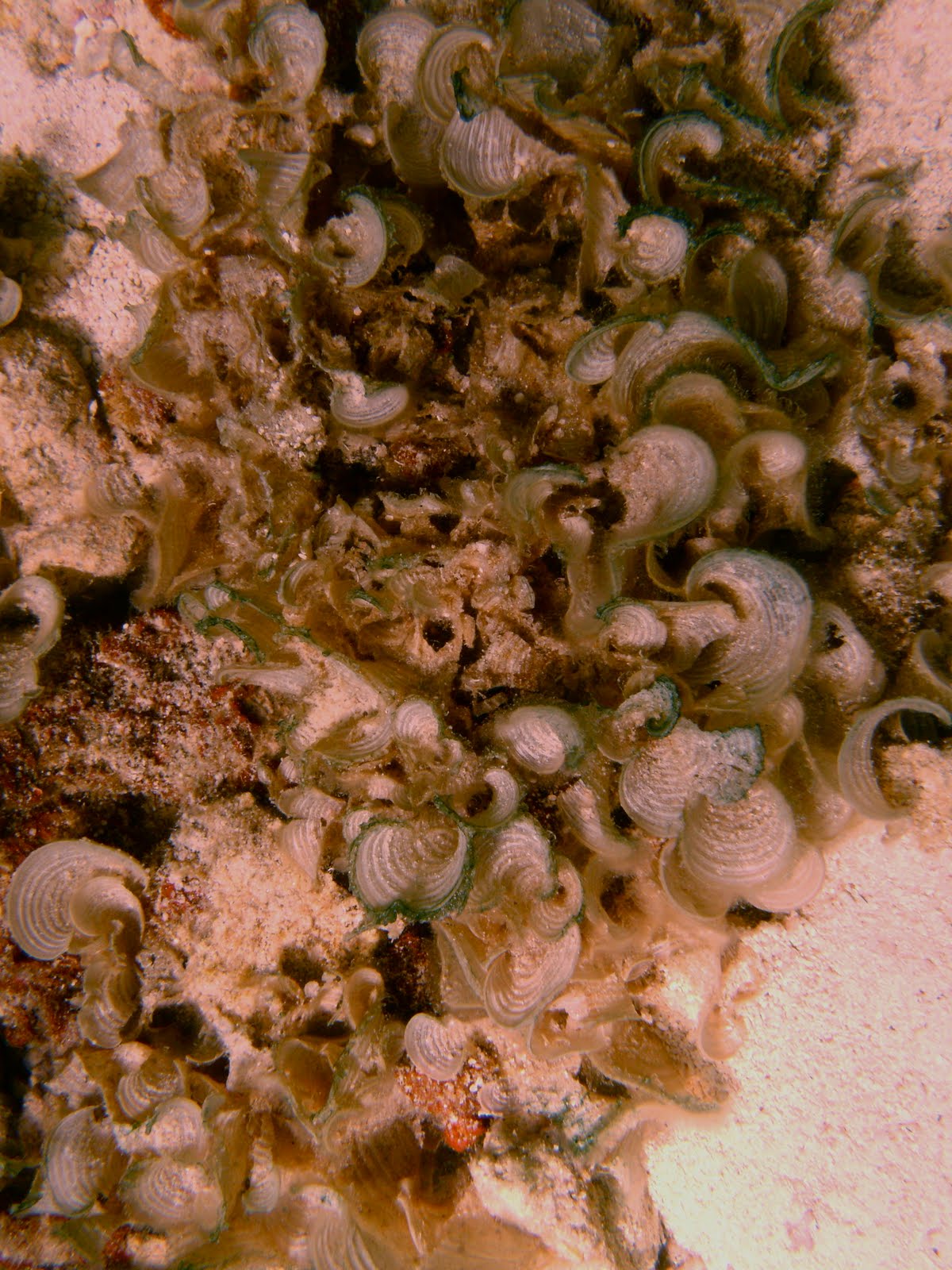
As we left the boat, we encountered an expanse of a beautiful curled and lacey Padina (thank you, Jen, for the identification) all along the bottom. This plant was structured like decoratively rolled pieces of thin parchment, making three-dimensional scrolled patterns over the bottom.

Swimming toward the inner wall of the reef, the coral became denser and more varied, with brilliant patches of purple, orange, electric blue, and lime green. Spotting the fish inhabiting this psychedelic wonderland took a moment, but once my eyes adjusted, the variety of fish was astonishing. The big parrot fish, unicorn fish, and jack were impressive, but my favorites were the much smaller squirrelfish that hung out in the shadows of coral formations in small groups. Unlike most of the other fish, these did not swim away when my dive partner, Marion, and I tried to photograph them. Instead, they often swam closer, as if to investigate what we were up to, staring at us with their wide, round, dark eyes. Their Christmas red bodies stood out brightly against the blue water, white sand, and cream-colored coral.

After most of us were back on the boat, a huge ulua swam between the boat and the coral head. The fish and the coral, both far larger than anything I had seen during previous trips to Hawai’i, attested to the health of this system and its ability to support a wealth of life.

On the way back to Sand Island, we headed out into the main channel to see the sunken water barge, some of which still juts above water. As we looked at the rusting hulk above water and caught glimpses of the even greater structure below, I found myself wondering what creatures had made the structure their own. Coral and sea cucumbers, almost certainly. Several varieties of fish, as well, I had to assume. Do sharks and honu (green sea turtles) cruise through the hulk, like they do Cargo Pier on Sand Island? What else might be there? Part of the magic of Midway, I think, is its ability to transform some of the remnants of human use (and abuse) of the Atoll into useful habitat and new life.

Friday, June 18, 2010

Shells and Plastic


Shells and Plastic
below my feet
adorn my life
protection and function
life and death

-Marion Ano

Sustainability Module


Aloha mai kakou,


Welina mai ka aina e kapa ia 'O Pihemanu! O au no Marion Ano. Hello to all you of you from the land named Pihemanu. My name is Marion Ano. We have been on Pihemanu for three days now. On this little atoll in the middle of the Pacific Ocean on a normal given day the population here ranges from 70 to 80 people. Although the atoll spans nearly two miles long and one mile wide the history of a much larger population of 5,000 people can be seen everywhere you go. With the departure of the military in 1996 and its officiation into the Midway Atoll National Wildlife Refuge the number of residents decreased dramatically. Under new mandate the U.S. Fish and Wildlife Service is responsible "to maintain and restore its natural biological diversity, provide conservation and management of the wildlife and habitats within refuge boundaries, provide opportunities for scientific research and environmental education, maintain the atoll's historical significance, and provide compatible wildlife-oriented activities to the visiting public". Taking a look around, I can see that the U.S. Fish and Wildlife works hard to fulfill it's mission. This is evidenced by the abundance of wildlife, the restorative work that has been done around the atoll, and the number of staff and volunteer hands that have come to Midway to give back to this aina. But, they have moved beyond their mission by embracing a sustainable future for Pihemanu. There is a strong sense of community here. If you've ever lived in a small place or spent time on a small atoll it's clear that people and their relationships to place, wildlife, and each other really matter. This afternoon, John Hanna, head of Chugach took our ohana, PAA (Papahanaumokuakea Ahahui Alakai) 2010, to show us steps they have taken to reduce the carbon footprint of the island. On our bikes with the wind in our hair we rode down to the transportation warehouse to meet our guide. From there we headed to the power plant. He showed us two generators that were in use during the military's occupation of the atoll. Today, these generators have been replaced by two modern day generators. The current daily power needs of Midway can be met by running one generator which uses 400 gallons of fuel per day. At our second stop we were greeted by Mr. Sak, the atoll's longest standing water maintenance supervisor. With 25 years of experience, John boasted that Mr. Sak could find and fix any water line on Midway. I was so amazed by his humility and year's of experience. To accommodate a smaller population and move towards a more sustainable and efficient water system, he adapted a "water pillow" system that runs off of two jacuzzi powered pumps in place of the larger and inefficient pump. Our last stop was the hydroponic garden. John shared that the garden produces 250 pounds of produce per week. Prior to this hydroponic production, the residents of Midway depended imported produce from the Honolulu. The power plant, water system and hydroponic garden clearly demonstrate that residents on the atoll show a strong commitment towards making the island a sustainable place to live for all life on the island. There are future plans to expand sustainability on the island by installing solar panels and perhaps harnessing wind energy that will not harm the wildlife and the birds that make midway atoll absolutely unforgettable and most inspirational. Most importantly, the minds and hearts of the residents here on Midway exude a sense of deep commitment to the wildlife, place, and their kuleana to do their part in creating a place that will be here for future generations to come. This place teaches us that we must all move towards creating a foundation that will live on.


Me ke aloha no,

Marion Ano

A Trip to Eas"tern" Island


A Trip to Eas”tern” Island

On the morning of our 3rd day, we were headed to Eastern Island. After breakfast we hopped on our bikes and headed for the boathouse. Once there, we sized our PFD’s (lifejacket) and headed for the boat. As we approached the boat, we stopped to see the Iwa (Frigate) birds resting in the Ironwood trees. I had never seen an Iwa bird that wasn’t flying.
We boarded the boat and were off to Eastern Island. The ride over was filled with excitement and wonder. What adventure would this magical place have in store for us?
As we approached the island you could see that there were no high level trees anywhere. The island was full of low shrubs and bushes. Tracy informed us that the Ironwood trees were cut down due to their negative navigational impact on the albatross.
Another noticeable feature was the sounds of the birds. They were much louder here then Midway. There was much more bird activity on Eastern. We listened to the many melodies and variations of the bird chorus. The albatross had their familiar shrills and beak claps, the terns had their high pitched whistles and screeches and the other birds filled in as background singers. The songs and bird activity became louder and stronger as we passed by tern nesting areas. The overhead hovering and midair dancing was very impressive. We walked single file with haste avoiding eggs, chicks and ground lying birds. There were so many eggs, that if it had been Easter we all could have easily filled our baskets.
The “Duck Seep” pond was a real oasis in the midst of nothing. The sighting of the ducks and ducklings was an added treat.
Everywhere you went you were engulfed by the growth of the invasive “Verbesina”.
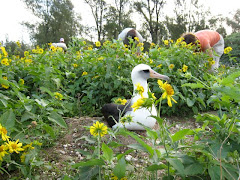
Like most invasive species, it has spread everywhere. The tall “Verbesina” makes for a very difficult and dense habitat for the albatross and other birds. There were open areas where native “Bunch grass” and groundcovers “Nohu” and “Alena” were successfully growing.
It’s very hard to imagine this peaceful and serene place was once the setting for the hustling, bustling war effort and historical “Battle of Midway. I really enjoyed the talk Tracy gave about the war and the island.
As we waited on the pier to leave, we sat and cleaned our shoes of thorns and seeds.
We saw a big monk seal lumber by and a honu sunning on the shore but what really caught our eye were the 5 or 6 big ulua swimming in 2 feet of water only 4 feet from shore. We all laughed at the thought of telling our friends back home that we could “throw net” and catch big ulua. That would be awesome!
Our ride back to Midway was filled with new stories and lots of laughter. We all had feelings of appreciation and thanks, Mahalo for the chance to visit Eastern Island Tracy!

Aloha,
Chris Baird

Thursday, June 17, 2010

Night Walking with the Birds


THE NIGHT RANGER AND PAA PETROL PATROL
By Hugh Story
6/17/2010

EGG-SPRESS YOURSELF
A clear night speckled with limitless stars blanketed our Wednesday night and our group was giddy after an afternoon of sifting through albatross boluses and starting our own Olympics-bound Synchronized Cargo Pier Jumping Team. Lookout Slovenia!

Led by U.S.Parks and Wildlife Services Manager Tracy Ammerman, our group set off to complete our mission: Locate a young ‘Ua’u, otherwise known as the Bonin Petrel, during a leisurely night’s stroll through the roads of Midway Atoll.

Although similar in sound, it should not be confused with petrol. The Bonin Petrel or Pterodroma hypoleuca, is an endemic bird to the Midway Atoll. I found it to not a particularly graceful bird when it comes to walking, as the Petrel can often be found stumbling about like a man making his way home after a night of heavy drinking. But still a beautiful bird nonetheless.

The journey started out safe enough but we would soon find out otherwise.
“Crack!”
“Splat!”
“Oh my God! What was that!?”
“Get the light! Get a light!”
An egg had just come out of nowhere and several members of the group just got yoked. We attempted to CSI the situation, putting forth several theories but no culprit was located. It was written off as a prank pulled off by adolescent teenage birds out blowing off some steam. Toilet paper and shaving cream didn’t follow so we continued.

Eureka! We found one. Tracy, our Night Ranger, walks over and scoops up the confused Petrel who must have been dazed with all the onlookers around it. We examined its docile behavior and white, black and grey feathers. It was magnificent. Our mission was a success allowing us to prove once again that a ‘bird in the hand is…” well you know how the rest goes.

THE BARKING BUSH AND AVE MARIA
“Ummm..did that bush just bark at me?”- I inquired to one of my fellow patrolman, certain that I had perhaps ingested too much Orange Tang over the last few days. But that wasn’t so…the bush WAS barking in a way along with a variety of other calls of birds found on the atoll. We had arrived at the sound station designed to imitate the sounds of native birds to assist in pairing. The Bulwer’s Petrel, or Bulweria bulwerii, is known for its distinctive sound to that of a barking dog.
Next to the sound station, was a shrine with “Ave Maria” inscribed on it. That thing too would not be immune to our photography as we began snapping pictures of it in assembly line fashion. I found it all to be a bit surreal…boluses, birds, barking bushes and a Hail Mary but a perfect way to end a magical day on Midway Atoll.

Anyone with information about the recent egging is asked to call us.

Albatross Stroll Module


Day 2- Albatross Module by R. Brennon

Can’t believe its Wednesday already! We’ve been on Midway now for two whole days. It’s my job to blog about our adventures this morning.

We were very fortunate to have John Klavitter, of FWS, talk to us about the albatross (or moli). He’s extremely knowledgeable, and he’s also extremely approachable – a wonderful combination. John has years of experience with the albatross and he happily answered all of our questions. It was good planning to meet with John on our second day on island, in that it gave us a deeper understanding of these amazing creatures we’re all conscientiously weaving around all day (everyone moves for the albatross – the golf carts, the bikes, the walkers –everyone). We learned a bunch of things from his talk. There’s too much to put into a blog, but here's just a couple of the facts that I thought were interesting:
There are 1.5 million albatross on Midway
There’s a chemical in the albatross’s eyes that gives them the ability to see at night
There are four common threads between the courting dances of different species of albatross: spreading wings, standing up on tippy toes, making some sort of call, and clacking their bills
Albatross chicks don’t produce their first bolus until they are about 4 months old…so that means that they collect a LOT of plastic in their gut through feeding

We've been learning about the albatross on our own, as well. We can't help but observe them as we move around the island. They are scattered everywhere, chicks sitting within a beaks reach, juveniles strutting about looking for love, hard working adults landing like jet planes in the middle of a block party. Juveniles erupt in spontaneous dances in groups of two or three or four. An earthen sea of endless somber chicks stretches to the horizon. The chicks look as if they've started getting dressed up in feather boas and wacky wigs, but quit halfway through their preparations. It would be impossible to go anywhere on the island and not look at the albatross.

They are amazingly big birds. Here's a picture to give some sense of scale...and remember, this is a fledgling, not an adult. The chicks sit back on their haunches, raising their feet up like they're lounging in reclining chairs no one else can see. They sit and patiently wait for their parents to bring their next meal. The adults move both through the air and on the ground. They are ungainly on land, waddling around on their big spatulas of feet, but once they hit the air they soar. Sometimes the chicks and adults seem to cuddle, sitting close to each other and touching each other gently.

All day long and into the night, the albatross make me laugh...not at them, but with joy. Their beauty and grace and clumsiness and goofy looks and lack of fear and novel voice all combine to create a creature impossible to ignore. They deserve our respect, and they deserve our efforts to stop impacting them negatively. One small choice by each person who reads this to change their habits in using and buying plastic can make a difference. It WILL make a difference. My choice is never to buy another plastic lighter. I've seen too many here on this island, and I know the path those lighters took to get here.

Cargo Pier Photo Shoot


Cargo Pier by J. Barrett


PAA Blog Post - Day 2: Cargo Pier (J.Barrett)

Wednesday afternoon we had some time to explore the nearshore waters surrounding the Cargo Pier. Aside from the mind-blowing blue hues, the most dramatic feature is the sudden drop-off. Long ago, the area just offshore was blasted and dredged to create a large dock for barges and ships. When NOAA vessels such as the Hi‘ialakai and the Oscar Sette arrive at Midway, this is where they dock.

We donned our snorkel gear and swam out over the sandy bottom, quickly reaching the drop-off. Not more than 30 yards from shore, clear warm water turned to a chilly blue abyss. Due to the depth and poor visibility from brisk winds, we headed for the shelter of the pier. The first piling we encountered was covered with small coral heads overgrown with algae and tangled with marine debris; a sad reminder of the long and complicated history of human impact on this seemingly pristine environment.

Looking deeper, we started to notice the fish. Large schools of goatfish and several species of ulua (a.k.a. Jacks) were the first to catch our attention. Then, further below, the faint silhouette of a large honu (Green sea turtle) headed in the direction of Turtle Beach where half a dozen other turtles were already hauled-out, basking on the beach. As we lingered, more fish began to emerge; nenue (a.k.a. chubs), Moorish Idol, needlefish, whitespotted toby, cornetfish and even a Hawaiian cleaner wrasse station.

This first taste of Midway marine life has everyone eager for our chance to explore part of the atoll’s reef of Friday afternoon!

Wednesday, June 16, 2010

Photo's from the field


Group Write and Poetry

In the evening of our first day we were guided skillfully through journal writing by Sarah and Doug. This was the result of the day’s experience …

“Moli kite
Ka’upu sit
Iwa soar with the sun.
Hollow bones
That uplift life
Hollow bones that make permanent Po beneath skin.” Nai’a


“Plastic Bottle Caps
Small & bright colours
They look like they bring life
They bring only death.

Sand Island
Fields of dark grey down
A mother feeds her baby
Soon Moli will fly

Surprise
Waves break on the sand,
We approach the rusting steel
Back up, it’s a seal.” Al

“albatross
sitting stone still
on the white sand near the
high waters mark
ghostly
wind blows through grey down
clouds grey
sun hidden
nearing dusk
alone
it does not move
eyes not seeing” Norbert

“Manu O Ku
Balancing in mid-air
Never far from your friend
Your fragile toughness and friendly hover
Welcomed friend to the sea farer
Lead us Home.

Young albatross
Today’s my day
I’m gonna try
Those overhead entrance me
How do they do it?
Spread my wings face the wind
Stretch, hop, hop, hop, what now?
I need to watch some more
At least there are many of us.” Chris

“I hope I always remember the adventure of today. Adults handed bikes and freedom, wind, blue skies, fuzzy moli chicks watching our careering progress with somber patience. I loved handing over my usual bag of leadership as I pedaled behind PA’A backs, straight and strong. A rag tag procession through the moli maze.

bike
sand
scrub
bike
hat
backpack
somber fuzzy moli chick
bike
tarmac
carcass
bike
sunburn
smiles
somber buzzy moli check
bike
eyewater
breathless
bike
silence
family
somber fuzzy moli chick” Randi Kika Brennon

Discovering Po


Day 1

Discovering Po.

As sun broke we were able to have our first opportunity to see what lay before us in the land of Po. We were “handed our bikes and freedom” and so began our journey with Pihemanu and the opportunity to explore all that was presented before us. We all set off from the same place, but dispersed in different directions, paths crossing along the way.

Myself, Sarah & Jen cycled to the affectionately named “Bulky Dump” and left our bikes to weave around the nesting fledglings who reminded us of their stand on the island with powerful “claps” of their beaks. Here, on Midway nature has the right of way!

At the end of the spit there were beautiful vistas onto light turquoise water that progressively darkened as the reefs shelved away into the lagoon. You could see Hawaiian Monk seals in the distance and Red Tailed Tropic birds flying above with the soaring albatross. The image is one as you might of a small Atoll in the middle of the Pacific Ocean – simply and overwhelmingly beautiful.

At the end of the spit there was a dead chick – I peeled back the feathers with a stick and the rib cage to find a carcass full of plastic – some large fishing floats and bottle lids. Nature’s genius creations of feathers and bones to protect was no protection for manmade materials. The impact of discovering this is so much more than seeing the photos – although hard to believe. Where did that bottle lid come from? Did the user ever realize it’s fate to our seas and oceans?

Do we ever stop in our daily lives and consider the journey of our latest toys, paintbrush, lighters or food packaging? The materials used to make it - the fuel needed for transportation and its eventual fate.

If one day we were all to consider the journey from the beginning of all the components of our purchases to their eventual fates and all the consequences in between – would we behave differently? We are in an era of convenience but convenience does not equate to better for us now or in the future. Life in all its forms takes time, care, and consideration to create fulfillment, health & happiness for the present and for our future and the legacy we leave behind us.

Sometimes we need to face the harsh realities of what we do to nature. The act of peeling away the feathers and breaking the rib cage and lifting the sternum – is like peeling away your consciousness. The contrast between this and the beauty of Midway does nothing but inspire and motivate change.

Consider this – in Johnstone Museum on the mainland we saw the beautiful cloak aha’ula – feathered cape of King Kamehamaha’s wife – originally. Sadly, after visiting England the King and his wife both died from measles and so the cloak was passed to his daughter. This large cloak showed the finest workmanship and was made from beautiful small golden yellow feathers from the “mamo” bird which covered the cloak. The bird catchers or “kia manu” would collect the feathers which there were only a few of on the wing and tail of each bird. The way this was done was to cover the branch with sticky sap and then once the bird landed they would carefully remove the molting feathers – clean the birds’ feet and return them to the cleaned tree. The work involved in this process alone showed how much time and care went into the making of that cloak. How happy the King’s daughter must have felt to wear such a beautiful cloak and proud the people who helped in its creation.

Do we feel the same way when we buy something that has had a questionable past and an uncertain future?

That is the magic of Pihemanu – the opportunity to let nature teach you, to consider our lives and journeys that will be influenced by Pihemanu but ultimately to think! While doing this we are so amazingly fortunate to be surrounded by the beautiful majestic creatures all around us – Albatross, Hawaiian Monk Seal, Fairy Tern and of course – all the people.

Introduction: Hugh Story

Hello,
My name is Hugh Story. I'm a part-time Global Studies teacher with the Pacific and Asian Affairs Council (www.paachawaii.org) at Aiea High School on Oahu.I work full-time as a sales analyst at the Hawaii Coffee Company (www.hicoffeeco.com).I'm a former Peace Corps volunteer in Kazakhstan ('99-'01) and worked as a small and medium enterprise development contractor in Kazakhstan and Bulgaria.I recently completed my MBA from the University of Hawaii. I'm a member of the Returned Peace Corps Volunteers of Hawaii and volunteer annually with the Great Aloha Run and Habitat for Humanity.Having grown up in Virginia Beach, I always had a connection with the ocean. Actually, my two years in the Peace Corps ended up giving me the most appreciation for the sea. Kazakhstan is the largest landlocked country in the world. In the center of the country is a point of which you are the farthest from any ocean. My assignment was in the middle of this country. I loved my experience but pretty much vowed to never be that far from water again.I'll be working on studying elements of Midway that can serve as a blueprint for a basic educational Flash-based video game. On occasion I've used higher end 'serious games' to help educate students and engage them. The best example is the Food Force game developed for the United Nations World Food Programme. It's a free download which engages students in 6 missions which covers the core duties and obstacles faced by food aid workers. Students put themselves in the role of an aid worker. It's very engaging and students ask throughout the semester to play the game again and again. I'll be giving a short-presentation about educational gaming before the trip.Our lessons have a sustainability component and we teach kids about limits with linear systems inherent in a global Materials Economy. I'm trying to find new ways to educate on closed-loop systems and have young people care about the environment around them. If resources allow, I would be interested in creating a small documentary of the trip. I'm involved with 'Olelo community television by producing, filming and editing various programs. I'm looking forward to meeting everyone and having an unforgettable experience.Aloha,Hugh

Introduction: Chris Baird

ALOHA EVERYONE,
MY NAME IS CHRIS BAIRD AND I AM LOOKING FORWARD TO MEETING ALL OF YOU. I AM BOTH VERY IMPRESSED AND A BIT INTIMIDATED WITH SOME OF YOUR BACKGROUNDS AND EXPERIENCES.
I AM A TEACHER AT OLOMANA SCHOOLS,WHERE FOR THE LAST 23 YEARSI HAVE BEEN ASSIGNED TO TEACH AT THE FAMILY COURTS JUVENILE DETENTION FACILITY.I AM A SOCIAL STUDIES TEACHER, BUT WE END UP TEACHING ALOT OF EVERYTHING TO A WIDE RANGE OF LEVELS,AGES,GRADES AND ABILITIES.I TRY TO BRING AS MUCH LIFE SCIENCE AND OCEAN STUDIES INTO THE CLASSROOM AS I CAN. WE'VE CONSTRUCTED AQUARIUMS AND TERRARIUMS,GROWN VEGETABLE GARDENS,MAINTAINED TARO LOI'S,RAISED FISH AND FROGS AND JACKSON CHAMELEONS.
I ENJOY PADDLING,SAILING,GARDENING,PLAYING WITH MY DOGS AND SPENDING TIME WITH MY WIFE MICHELLE AND MY SON NANEA.I AM A LONG TIME PADDLER AND BOARD MEMBER OF HUI NALU CANOE CLUB. I AM ALSO A MEMBER OF THE POLYNESIAN VOYAGING SOCIETY AND CREW MEMBER ON THE VOYAGING CANOE "HOKULE'A".
I SPENT MOST OF MY YOUTH GROWING UP ON KAUAI. I HAD A FANTASTIC CHILDHOOD LIVING IN WAIMEA. AS KIDS, WE COULD SURF AND DIVE IN THE OCEAN, SWIM AND FARM IN THE VALLEY AND HIKE AND CAMP UP IN THE MOUNTAINS OF KOKE'E. ALL THESE ACTIVITIES KEPT US OUTSIDE ENJOYING NATURE AT HER BEST..I STILL ENJOY GOING UP TO KOKE'E AND PICKING MAILE AND MOKIHANA.
AS KIDS ,WE PRACTICED CONSERVATION AND RESOURCE MANAGEMENT WITHOUT EVEN KNOWING IT. WE WERE TAUGHT TO TAKE ONLY WHAT WE NEEDED AND TO SHARE ANY EXTRAS WHETHER IT WAS FISH OR TARO OR MANGOS.
AFTER HIGH SCHOOL, I ATTENDED WESTERN WASHINGTON UNIV. WHERE I MAJORED IN PARKS AND RECREATION. ONCE AGAIN, I FOUND MYSELF INVOLVED IN ENVIRONMENTAL ACTIVITIES AND PROJECTS.
I LATER RETURNED TO SCHOOL AT THE UNIV. OF HAWAII WHERE I GOT MY TEACHING DEGREE WITH THE INTENT ON RETURNING TO TEACH AT WAIMEA HIGH SCHOOL.WELL..........THAT WAS 25 YEARS AGO AND I AM STILL HERE IN HONOLULU.IT'S ALL GOOD!!!!!
MY MAIN ENVIRONMENTAL INTEREST THESE DAYS FOCUSES ON THE REMOVAL OF INVAISIVE ALGAE FROM MAUNALUA BAY IN EAST OAHU. A NUMBER OF YEARS AGO UNDER THE GUIDANCE OF DR.ISABELLA ABBOTT,CELIA SMITH AND DR.KIM PEYTON, MY WIFE SPEARHEADED THE REMOVAL OF INVASIVE ALIEN ALGAE PROJECT. WE WORK WITH AND TRAIN HER STUDENTS WHO THEN TRAIN COMMUNITY VOLUNTEERS IN THE REMOVAL OF ALIEN ALGAE. MY WIFE HAS ADDED THIS PROJECT INTO HER CURRICULM AT KAISER HIGH SCHOOL.IN THE LAST COUPLE OF YEARS OTHER COMMUNITY ORGANIZATIONS HAVE BECOME INVOLVED IN THIS NEVER ENDING PROJECT.
WE HAVE ALSO TAKEN MY WIFE'S STUDENTS TO THE ISLAND OF KAHO'OLAWE WHERE WE TOOK PART IN OPIHI MONITERING AND FISH (PAPIO)TAGGING.WE HAVE ALSO GONE TO THE BIG ISLAND TO PLANT KOA SEEDLINGS AND HELPED TO CLEAR INVASIVE MANGROVE FROM HE'EIA FISHPOND.
I AM LOOKING FORWARD TO SEEING BOTH THE ISLAND AND SEALIFE ON MIDWAY. A LITTLE OVER A YEAR AGO I WAS FORTUNATE TO SAIL ON THE HOKULE'A TO PALMYRA ATOLL. IT WAS A WONDERFUL EXPERIENCE AND I LOOK FORWARD TO COMPARING PALMYRA WITH MIDWAY.I AM ALSO LOOKING FORWARD TO SEEING THE REMNANTS OF WWII ACTIVITY.I HAVE WATCHED ALOT OF THE HISTORY CHANNELS SHOWS ON MIDWAY.
TAKE CARE AND I'LL SEE YOU SOON,
CHRIS BAIRD

Introduction: Marion Ano

Aloha e nā hoa,

‘O au nō, Marion Ano. Welina mai iā kākou! I hope this message reaches all of you in good spirits. I can’t believe we are a week away from our trip to Midway Atoll. I look forward to meeting each of you in person this coming weekend. I know this lifetime opportunity to travel to Midway with all of you will deepen my knowledge and aloha for the ocean. Furthermore, this experience will strengthen my ability to advocate for the protection and rightful use of this amazing life-sustaining resource.
For me the ocean has been a great teacher and I’m continually humbled by its vastness, power, and greatness. It saddens me that our oceans have been incredibly depleted of its resources and polluted by humans. I look forward to discussing these issues with each of you and hopefully we can develop solutions to solve some of the challenges and problems we face.
In my current work, I am an intern at NOAA’s Pacific Services Center. As a geospatial processor, I’m working towards creating data visualizations or interactive visuals that utilize NOAA’s scientific data to help students, teachers, and the others understand the different processes, impacts, and dynamics that are occurring on a global, national, and local levels.
Mahalo for this opportunity! See you all soon!

Ke aloha no,Marion

Thursday, June 10, 2010

Introduction: Sarah Wilson

I grew up in a small coastal town in San Diego County, California (Vista, California). My family had a sailboat when I was growing up so I spent summers exploring around Catalina Island. I loved fishing as a child and snorkeling the most and would spend hours in the water. These ocean experiences sparked my passion for the sea and its creatures and I knew since I was 6 years old that I wanted to be a marine biologist. So that is what I do with most of my time... I am on, in, and around the ocean as much as possible and happiest when I am sharing the wonders of the sea with others! I studied marine science at UC Santa Cruz and received a BA in Biology and then a MA in Science Education from San Diego State University. I currently am the Ocean Education Manager at the National Geographic Society working on the new Ocean Now Initiative and recently traveled the world by private yacht teaching all school topics, scuba diving, and marine biology for 5th, 7th, and 9th grade students. I have worked in education management, animal care and training, exhibit creation, instruction, and program development at top institutions including Sea World, San Diego Zoo, Birch Aquarium at Scripps, Dolphin Research Center, and the Ocean Institute. In addition, Sarah I work as a science and education specialist publishing books, websites, and teaching guides for National Geographic, Scholastic, IMAX Films, Scripps Institution of Oceanography, and the multi-agency marine portal website Thank You Ocean (www.thankyouocean.org). I also have extensive marine field research experience ranging from being a NAUI Scientific Master Diver in kelp forests and coral reefs to a sea turtle and marine mammal observer. I have spent over 15 years working as a Naturalist on various ships all over the world introducing the wonders of whales in Alaska, Baja Mexico, and Hawaii to teaching snorkeling and diving around the globe.
I have dreamed of visiting this beautiful remote chain of islands for years and that desire has grown even more since its creation into one of our Marine National Monuments. A place that “seems” so far removed from human impact is filled with evidence of our capacity to harm the ocean and its wildlife. Papahanaumokuakea is an ultimate learning laboratory for the marine environment due to the presence of species that are both robust and fragile in their nature. I am looking forward to learning and experiencing a wild and special place that is a baseline for conservation as well as an area in need of preservation due to the quantity of endangered and diverse species. The islands are so unique and inspire action for protection and awe from its beauty. My project plan is to teach and inspire others about the ocean through the creation of a series of workshops to be held across the country to ocean stakeholders, such as boat captains, lifeguards, and those in the scuba diving industry. These workshops will supply ocean information and outreach materials to those on the front line of public interaction about our ocean and will enable these stakeholders to inform their visitors on ocean issues and conservation. We have the power to damage or protect our own backyard, local seashore or waterway, or a place that seems a world away like Midway Atoll.